Wednesday, March 16, 2022

Irish Novel on Sale + "Behind the Scenes" Look!

Warmhearted Irish novel
My Irish love story, Becoming Emma, has been selected for a special Women's Fiction Sale on Kobo starting today! 

The sale pricing applies to Kobo's UK, Australia, and New Zealand regions—and is also available on Amazon UK and AUApple, and other ebook retailers!    

While this blog is mostly about gardening and homesteady stuff, here’s a little of what I do when I’m not working around our place…

Behind the Scenes...

Becoming Emma follows Dublin girl Emma Carey's search for love and home and family in the most unlikely of places. One of the story events is actually is a big St. Patrick’s Day party...so I thought I'd share a brief look at how the story came about.

Although much of this novel takes place in a new locale near Seattle, Washington, another big part of Becoming Emma takes place in the village of Ballydara, my fiction series set in County Galway, Ireland.

My Irish stories are set in a rural area that’s been inspired by a few other places, real and imaginary. As a country-dweller who lives in a somewhat remote area, several miles from a tiny town nestled in fir-covered foothills, I incorporated my favorite elements of my true-life, local village into my fictional Galway setting—for example, the beautiful scenery where I live and the fact that there’s no mobile signal or high-speed internet. 

I also invented an Irish version of our village: both have a small shop, a church, and of course, a pub, where, as they say, “everybody knows your name.”

In creating Ballydara, I also drew a bit of inspiration from two beloved BBC series: Ballykissangel, set in a little Irish community, and Doc Martin, which takes place in another picturesque locale in the British Isles, on the coast of Cornwall. Hopefully, the residents of Ballydara are as endearing as the television characters, but not quite so daffy!

It’s funny, how one’s fictional characters and story worlds evolve. I began a novel about my Emma character and her love interest Declan O’Donoghue years ago, with a different title. But the story just didn’t come together the way I wanted it to and I put it aside.

As a few years passed, Declan’s family became so clear in my mind I wrote two “novelette-length” short stories about them--the first from his dad Frank’s point of view, The Secret Well. The second story, The Christmas Visitor, is from his mother Maeve’s point of view. But it was Hazel, Emma’s mysterious sister, who changed Maeve and her family.

Both stories were deeply entwined with the bigger story about Declan and Emma, still waiting to be written.

 I was still scribbling little bits and bobs about Declan and Emma, even a chapter here and there, but I still wasn’t ready to get going on their story. I went on to write two other Ballydara books, The Hopeful Romantic and The Galway Girls.

Then the time came when Emma and Declan insisted that I tell their story—and Hazel’s too. As I finished a huge, rambling draft of a novel, titled Becoming Emma, I had an epiphany: this very long book was actually two novels—at around 800 pages, it was just too much story for one book. 

Then for a fun, summertime project, I wrote a prequel about Emma, before she met Declan, The Little Irish Gift Shop—and all three novels became The Fairy Cottage Mini-series. I went on to publish Becoming Emma, then...

I ended up releasing a Special Edition of Becoming Emma, which includes the two connected short stories The Secret Well and The Christmas Visitor in the correct reading order. The second part of this big story, The Fairy Cottage of Ballydara is the sequel to Becoming Emma, and will be out this spring!

If you celebrate St. Patrick’s Day, I hope you’re enjoying your Irish festivities... Just for fun, here's a couple of pics from our trip to Ireland a few years ago. You can find more about my Irish novels and my homesteading too, at www.susancolleenbrowne.com!

John and I at St. Patrick's Mountain, County Mayo

A wee traveling cart in Dingle, County Kerry


Thursday, March 10, 2022

Mulching and Compost, Magic for your Garden!

In my experience, mulching is the single most important factor in organic food-growing success. Mulch builds your soil fertility, suppresses weeds, prevents winter soil heaving, and helps regulate your soil moisture and temperature—it’s the magic pill for your garden!

I go into detail about mulching in my free ebook, Little Farm in the Garden. So for this post, I’ll just share a few ideas I’ve had lately about the mulching process—the quick and dirty version!

Do #1: Ideally, I put my food-growing areas to bed for the winter by covering the soil with chopped leaves (or leaves that have been decomposing for a while, known as leaf mulch), then a layer of compost on top. I also use a lot of dead brakenfern, because we literally have acres of it.  

In any event, we have such a rainy climate that the leaf matter and compost stays nice and moist all winter. Until it doesn’t.

A couple of weeks ago, after all the snow had melted, a late winter Northeaster—very cold, dry air—roared through Berryridge Farm. I’d thought the soaking rains we’d had just before this storm would keep the leaves wet enough to stay put. But no. All the chopped leaves and my lightly-applied compost dried out in no time flat.

Watching that high wind peel most of my mulch right off the beds, the mulch I’d applied so conscientiously, I realized where I’d gone wrong.

I generally am not able to create enough compost for all my beds from my kitchen compost pile —there are just two of us generating fruit and veggie scraps for the raw material. Which leads me to:

Do #2: For fall mulching, unless you have enough compost to cover the entire bed with at least two inches of it, you might try this instead. You can still top the mulch with whatever compost you have available, but then cover your mulched beds with lots of heavy vegetative material. You can use prunings, bark, or even cardboard, if you weigh it down. But I’ve had plenty of cardboard fly off my beds too!

If you’re thinking of re-mulching your beds for spring, you don’t necessarily want a super thick mulch layer. Although it will retard weed growth, it will also prevent your soil from warming up for seed germination.

What I’m trying is scuffing the top layer of soil a little, then lightly incorporating a layer of chopped leaves. I’ll still put compost on top, but this way, I don’t have to see an entire layer of leaf bits fly away in a brisk breeze.

John has created a good sized pile of thick bark from a big old alder he’s been processing for firewood. For my spring bed prep, I’m going use the bark on top of the mulch to control weeds, then I’ll remove the bark maybe two or three weeks before putting seeds in the ground to let the soil warm.

Do #3: Keep a supply of mulch for top-dressing your beds. Or at least for those crops that require mulch for a decent harvest.

For example, when I plant garlic in November, I top with soil with a very thick layer of chopped leaves and a LOT of compost. This is one crop I thoroughly cover—after all, being underground for 3 ½ months before sprouting, the seed garlic needs to be protected from weather before the little green shoots appear.

Potatoes are another crop that needs lots of mulch. Without some kind of top dressing, the spuds near the surface often get exposed to sunlight, which turns the skins green. Those green spots are toxic, so keep those taters covered!

Count blueberries as a third crop that definitely requires mulch. The roots need to be kept very moist, but they are shallow—many of them barely below the surface. So applying mulch will keep the roots happy. But…do not apply composted chicken manure. Blueberries love acid soil, and any manure-based mulch or compost is too alkaline.

Do #4: If you’re short on leaves and looking at options other than home-grown mulch…In the last couple of food-growing seasons, I’ve covered my veggie beds with cardboard. It’s generally because I haven’t kept the beds weeded, and the weeds got so dense I had to apply a “killing mulch.” Cardboard does indeed do the trick: cover an empty, weedy bed in fall and you’ve got beautiful soil by spring.

The good news is, earthworms love it.

The bad news is, so do slugs. So anywhere you have moist cardboard, you’ll be sure to be raising a good crop of baby slugs. The other downside is, after a long winter, your cardboard will often be in tatters, and you’ll be picking up those pieces of cardboard all over your yard all spring and summer.

It’s true, the cardboard will eventually break down in a couple of years, but unless you have a spot out of sight for all that rotting cardboard, it’s pretty unsightly. I have also used thick layers of newsprint as a killing mulch, but again, there's all that decomposing paper to deal with by spring.

On to “Don’ts”...

Don’t #1: It’s a small but important detail: Avoid using fruit tree leaves or prunings for mulching. They generally contain a lot of funguses that you don’t want to add to your soil.

Don’t #2: Well, it’s not exactly a Don’t, just a caveat: Use other killing mulches with caution.

True Confessions: I have sometimes let my beds get so weedy I need something stronger than cardboard: I have to “fry” those weeds—covering some areas with scrap steel roof panels. In the summertime, the ground beneath gets so hot the weeds just cook to death in a number of weeks.

The problem is, the soil “cooks” too—including all the beneficial microbes and other goodies. I have noticed the crops where I’ve used steel panels on the soil have never thrived. This year, I am rebuilding the soil in those areas’ with more leaf mulch. I’ll still use the panels, but only on pathways.

Black plastic: it’s one of the most commonly used killing mulches. And it sure does work! Once year we bought two large packages of black plastic sheeting and used it all over the place. Our weed problem was solved.

But solving one problem often creates another. Being the thrifty gardener that I am, over the next few years, I reused the plastic. Over time, that plastic breaks down, and I subsequently spent many, many hours picking bits of it out of the soil. My concern was, and is, that birds will think those shiny little bits are yummy bugs and will eat it. So, I’m not longer a fan.

Little Farm in the Garden has an entire chapter about mulch and compost—I hope you’ll take a look! You’ll find the free ebook at Amazon, the Apple Store, Kobo and all other ebook retailers. 

If you’re a food gardener, what are your mulching dos and don’ts?


Thursday, March 3, 2022

Hawk Attack Aftermath

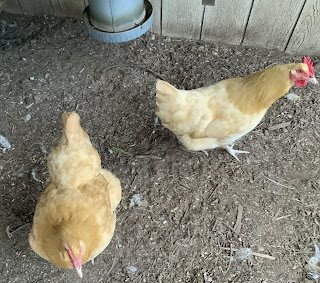
Last two hens
It’s been over ten days since a red-tailed hawk killed one of our hens--and the two remaining girls are still traumatized.

For the first five days after the attack, they wouldn’t leave the coop--not for food, not for water. It appeared that they were spending the days just milling around the coop floor or hanging out on the platform under their roost.

I would open the man door and try to reassure them they would be safe, coax them out with feed or scratch, but they wouldn’t budge. All I could do was sprinkle some feed on the wood chips on the floor, which they would peck at halfheartedly. I put a bucket of water in the coop too, since they wouldn’t come out to drink out of their regular waterer.

Their eating pattern had changed too: usually, fresh feed in the feeder would have them eating with gusto. Now they’d only peck at the bits, once, twice, then stop eating, lift their heads and look around.

Finally, the day came when they came out of the coop of their own accord. Since then, they are emerging once or twice a day to eat--once again, do their "peck-peck-look around" for only a few minutes. Then they'll disappear back into the coop.

Yesterday, I did see an encouraging sign they might return to their normal, energetic girls: there were little round depressions in the loose dirt in one corner of their caged pen—they’d been dust-bathing! 

Dust-bathing is an instinctive behavior of laying hens: they will scratch out a shallow hole, and sink right into it, fluffing the soil around them with their wings. The goal is to get dirt in and among their feathers, which apparently discourages parasites.

Despite that positive sign, there’s another distressful indication that things aren’t right: they’d been excellent layers before the hen was killed, but the two girls left haven’t laid since the attack.

After a hawk killed one of our hens years ago (our first flock), the five girls remaining had also hunkered down in the coop--but only for three or four days afterward. These two hens are clearly less resilient.

I wonder if it’s the breed: the girls are Buff Orpingtons, more of a gentle type of laying hen. And since this flock (before losing the three to predators) has been so prone to broodiness, it could be they’re very comfortable spending days on end inside their coop.

But it’s sad to see them decline. Without light, their combs are turning paler. And they seem to have lost their zest. What wouldn’t I give for one of them to peck at my legs again, telling me, “C’mon, I want some special treats!”

With the constant pressure from predators around here, sometimes I feel we’re in a losing battle. Our neighbors lost a 3rd hen the week before the attack at our place—and now they’re down to only three chickens. They, and John and I, have come to the same conclusion: our only solution to get our hens back into light and free-ranging opportunities is to cover their yard with netting or steer wire.

For us, it’ll be a big job: our yard is at least 15’x15’. We’ll need some new supports going down the middle, and the way hens scratch, making huge divots in the ground, it’ll take a lot of muscle to bury the supports deep enough.

For now—at least until our two girls are interested in venturing back into the sunshine—their caged pen will have to do.

We have already changed our egg consumption. Gone are the days of being lavish with our supply, having eggs whenever we wanted: 3-egg omelet, anyone? 

Not any more. We currently have a bunch stored in the shop fridge, but without any expectation of more eggs, we will be parsing out our intake. The next step is buying store eggs for baking, to help stretch our own supply.


But whatever adjustments we need to make to our eating or our homestead, I just want our girls to feel safe again.

Thursday, February 24, 2022

Another Hen Killed

Hawk in our woods
Yesterday, we lost another one of our girls.

But she wasn’t really lost—she was killed by a hawk. Right in front of my horrified eyes.

It was getting close to sunset—the girls were getting their last minutes of scratching in their yard, and in minutes, they would be going into the coop for the night. Ready to head outside and say hello to them, and top up the feeder, I gazed out the dining room window at the hen yard.

I saw something strange: instead of the usual dark ground near their door, there was light stuff scattered all around.

Then movement in the middle of the light stuff. An animal.

The light stuff was obviously feathers.

“John!” I cried out. “Something’s got the hens!”

The attacker wasn’t that big. I started to cry as John ran to the back door and shoved his feet into his shoes. A small coyote? Then the animal moved its head. A red-tailed hawk.

I yanked on a sweatshirt as John raced outside. The hawk must’ve heard a human coming, because it flew off. I caught up with John next to the fence. He said, “She’s still moving.”

“Get some gloves on, honey." My breath caught as I entered the chicken yard.

There was a hen, lying on the ground—a big bloody gash at the top of her breast. And completely still.

Crying, I called to him, “She’s not moving now—you must’ve just seen her in her death throes.” As he went back to get a coat on, I looked around the yard. So where were the other two girls?

I hoped against hope they had gotten into the coop in time. I went inside and saw only one hen. She was milling around, not on the roost. “You’re okay, I said softly. Still, I was only a little relieved.

I went back into the yard and looked around. Some twenty feet away from the dead chicken, in the corner next to one of the woodsheds, I saw a patch of blond and ran to it.

It was a hen. She’d wedged herself into the corner to tightly she was halfway under the slats of the shed. She wasn’t moving. Yet there was no blood. Or feathers on the ground.

But I was afraid she was dead too—of fright. I stroked her back. “Are you alive, little girl?”

The hen moved ever so slightly. “Let me pull you out,” I told her, and gently put my hands on either side of her and drew her toward me. She resisted, and only burrowed further under the slats.

The fact she’d been strong enough to resist must prove she was uninjured. I raced out of the pen and around to the shed. Boxes of small logs and wood scraps were piled in the corner where the hen had taken cover. I pulled the boxes away—and there she was, whole. She blinked.  

“You are alive,” I said in relief, and John approached. “I’ll bet she’ll want the rooster to help her,” I suggested, and he was able to lift the unresisting hen. We returned to the coop, and he gently placed her inside.

Two live hens. It was something to be grateful for. Together we returned to the dead hen. 

I’d seen worse, when a cougar had gotten our first flock and left pieces of the chickens all over the pen. But still, I started crying again. “I’m sorry honey, this is my fault.”

“No it’s not,” said John. “It’s just nature. And remember, we just lost two hens on my watch."

It's true, John had been in charge in my absence. But this—the hen getting killed—felt like my fault: I’d let them out of their cage just a half hour ago. When the hawk attacked I’d been only moments from going to their pen. The girls had been only moments from going into their coop.

“We’ll bury her where I buried the other hen,” John said. The hen from our first flock years ago, that had also been killed by a hawk. He lifted the dead hen. Her head dangled. “Her spine’s been completely broken.”

“I’ll dig the hole,” I said. Still crying, I grabbed a small shovel and followed him to a stump a little ways from my compost piles. He cleared away a bit of brush.

Angry with myself, I savagely sank the shovel into the ground.

Losing this hen felt so different from the other two last month. Then, there had been no bodies. And I’d been away caregiving, my mind full of worries and the family troubles I was facing. Now, actually seeing the hen killed hit me in a whole new way.

Not that helping to bury her helped. I dug a small hole about a foot deep, and John nestled the hen in it. He covered her up, filling the hole and patting the earth as he finished. “You’re safe in hen heaven now,” he told her.

“Away in the Happy Hunting Ground,” I said, and trudged back to the coop.

I went to say hello to the other two hens—they were still awake--and filled the feeder. One of them actually came out to the feeder and nibbled a little. Then as they climbed on the roost, I returned to the yard and tried to clean up the feathers, raking them into two piles. But there were still so many more scattered around.

We had a big northeaster coming early the next morning, and I hoped it would blow the feathers away. To help take away my memory off the killing.

I knew John’s heart was as heavy as mine. Before he went in, I said, “Now that the hawk knows it’s found a sure food source, it’s going to keep coming back here until it gets every last hen.” He nodded soberly.

We both knew the hen-caring policy we’d started a few weeks ago had been wrong.

We’d always wanted to let the hens out of their wire-covered cage every day, to scratch and nibble on weeds, get a little sunshine—or on a cloudy day, simply get some natural light.

But that would be in the past. Going forward, we couldn’t let the hens out of their cage into their uncovered yard just because we were home, and could see them through the window. Nor could we let the hens out while we were outside, doing garden chores or firewood chopping.

The new policy: we absolutely can not let them out of their cage unless we are right there in the yard with them. Hawks are such majestic creatures, but with this attack, I hated them.

It was a hard lesson.

And now our little flock is down to two.

Happier days, happier hens

Thursday, February 17, 2022

Absent Homesteader Redeemed

Mid-February harvest

I thought the crop was a goner.

 Of all the chores I’d neglected since October,  harvesting the russet potatoes was at the top of my list. 

After my Yukon crop had been such a bust this year—terrible scab and insect damage—you’d think I would have been highly motivated to give my russets better treatment. Especially since I’d learned that in our garden, the variety has proved to be much more resilient than Yukons.

 But no. Last fall, when I began to be away from home for weeks at a time, I was forced to neglect loads of garden tasks: weeding, mulching, and compost top-dressing. The result was that entire planting beds went to rack and ruin.

 And here was my crop of russets, unmulched and un-top-dressed, the bare soil exposed to the ravages of winter. The bed was full of weeds too, with the dead potato tops decomposing so you hardly knew where the hills were. It was also the planting bed the closest to the house, so I was unable to escape the sad sight.

Through the fall and into winter, as the rains poured down, the snow arrived, and we had record breaking low temperatures, I never got around to harvesting the bed. I’d gaze at it out the “great room” windows (kitchen/living/ dining room), feeling the potatoes reproaching me. 

My conclusion: the taters had likely rotted in the ground. So no way would I get any decent potatoes out of that mess.

And I hate waste. I’d wasted the money we spent on potato seed, wasted the time and energy I’d put into planting and tending. Wasted all that food. But as much as I wanted to, I couldn’t turn back the clock.

 Upon finishing another caregiving stint, John and I arrived home this past weekend. I had a list of garden chores as long as my arm, and was determined to start catching up on planting bed preparation for spring. 

And the russet bed, since it had to be full of rotten potatoes, was the priority—since nothing could be planted in there until I got the yucky stuff out.

 So yesterday afternoon, after the hens had turned in for the night and the light was waning, I fetched our spading fork, and reluctantly stepped up to the russet bed. Pushing in the fork where, at my best guess, there had been a hill, I lifted up the soil once, then twice, and turned it over.

And what do you know, six medium brown ovals appeared: russet potatoes!

 In the dimness, I peered at the spuds. They were caked with dirt, of course, which could and generally did hide a multitude of flaws. But they were definitely not rotten!

Apparently the super-hard freeze we’d had at Christmas and the week after hadn’t extended eight inches below the surface, where the potatoes were. And maybe the foot of snow on top of the bed, which had taken most of January to melt, had kept the soil from freezing that deep as well.

I proceeded to turn up the rest of the hills—and found a healthy yield with each one. Lots of little guys, but some good-sized spuds too, perfect for baking. The proof, though, would not be in the pudding—it would be after I hosed these puppies down.

So I gently piled the spuds in my little plastic basket/sieve, got out the sprayer and turned the hose on the taters, rolling them in the basket to make sure every potato got rinsed. It was dark by now, and my mittens were soaked—time to quit for the night.

 Bringing the potatoes inside, I saw two small ones were blackened. But other than that, the crop looked sound! I said to John, “We won’t know for sure they’re okay until we cook ‘em.”

 He agreed, and I rinsed two medium-sized spuds thoroughly, pierced the skins with the tip of my paring knife, and popped them into the oven. We really wouldn’t know for sure, I thought, until we ate ‘em.

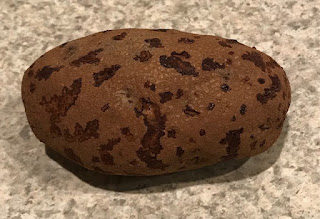
After an hour and 10 minutes at 370 degrees, I pulled them out. The baked potatoes were covered with these weird spots. But other than that, they seemed okay. 

Weird spots close-up

Cut open, and the insides fork-mashed with butter, the spuds were actually tasty! The spots had had no impact. My guess is, that long storage time in very cold soil—colder than refrigeration—had turned much of the starch in the potatoes to sugars. So the sugars leaked from the piercings and maybe through the skin too.  

 In any event, John and I are used to home-grown produce that is far from perfect looking, so we were good to go. And now we should have enough potatoes for the rest of the winter.

 What I learned was, russet potatoes are far more forgiving and resilient than I ever figured. Which makes them a great homestead crop: lots of good calories and nutrition for little effort.

 Still, I don’t recommend letting your russets overwinter in bare soil, whatever your climate!

Friday, February 11, 2022

Perfect Homestead Crop

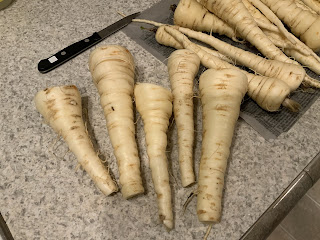
Freshly harvested parsnips!
This crop is easy to grow, overwinters like a dream, plus it’s tasty and versatile!

I’m talking, of course, about parsnips. To grow them organically, you only need fairly good soil—that is, with plenty of organic matter, but no special amendments—and plant in full sun. 

You’ve got a pretty wide window of sowing time too—in my experience, you can put your seeds in the ground from early May to the end of the month. Keep them watered and mulched all summer long, and you’re good to go.

You’ve got plenty of flexibility when it comes to harvesting parsnips too. I always wait until after the first frost—the roots reach their full sweetness only after a good frost. After you cut off the greens, you can toss them back on the bed for mulch and extra organic material. Keep in mind, you can continue to harvest your parsnips as needed, as long as your soil doesn’t  freeze solid.

We had a mega freeze before Christmas, and the snow in our garden didn’t melt until late January. I had been out of town, and just got around to harvesting about 1/3 of the bed days ago. I roasted a big panful, and oh, were they sweet!

Hint: but don’t wait too long. I have harvested parsnips in mid-March, after the tops started growing again. Unfortunately, the roots were woody and sort of tasteless.

But when you harvest your parsnips within the optimal timeframe, the taste is incomparable! My favorite preparation is to peel the roots, cut into chunks, and drizzle with olive oil. Sprinkle a little salt on top and roast at about 360 degrees until they’re soft and golden. I also peel them for a sauté with carrots, onions, garlic and celery, then add to any kind of veggie, meat based,  or bean/lentil soups.

Washed and trimmed, with good color!

Parsnips, being a starchy vegetable, also have a leg up on other veggies without a lot of calories. Full of Vitamin C, they can add a little more robustness to your food intake—a bit like potatoes.

At our local co-op grocery, organic parsnips are $3.99/lb, and don’t look all that great. You can plant a whole bed for 4 bucks worth of seed!

Parsnips especially come in handy when you haven’t had a chance to make a trip to town for groceries, and are running low on fresh veggies. 

A trip out to the garden—sure, the beds will be muddy in winter, and you might have to really put some muscle into it to work those roots out—but parsnips are well worth the effort!


Thursday, February 3, 2022

Disappearing Hens

Scratching in leaves
Our little flock of five laying hens has dwindled.

This past week, we lost one hen, then three days later, a second. Both times, it happened in broad daylight. 

The flock was free-ranging in the orchard, in plain view of the house. But I was away caregiving, and John never heard the hens’ alarm calls—when hens sense a threat, the entire flock will buck-buck-buck like crazy.

From the small amount of evidence—a couple of patches of blond feathers on the ground, a sprinkling of more feathers close by—John and I guessed both girls were killed by a hawk or owl. Both raptors are a common sight around here, and could easily have swooped down, picked up a chicken, and taken flight.

Our previous flock was attacked by what we believe was coyotes—there was a trail of feathers going from the pen to deep into the woods. Years ago, with our first flock, our four hens were killed by a cougar. I saw the big cat the day it killed one hen. Two days later, it got the last three, leaving pieces of the corpses all over the place. (See my 2013 posts.)

What’s particularly different about losing these two girls is that the remaining three hens haven’t shown any signs of trauma. The other times a hen was attacked, the other girls hid in the coop for days on end. And they were jumpy and temperamental long after that.

But maybe these girls never even saw their "sisters" being attacked. We've often had a hen linger by herself out in the orchard, while the others have gone into their caged-in run to eat or do their dust-bathing. 

Four girls safe in the “caged” pen

I have noticed our most dramatic wildlife incursions have happened when we haven’t been spending much time outside. If we’re away from home, I suppose the wild animals are sensing the lack of human scent and presence. Even if only one of us is gone, that’s still one less person out in the yard—and it could be that just the one person isn’t putting off the wild critters like two would.  

Five hens made for a bustling little homestead flock. Our girls got along well, were the cleanest flock we'd ever had, and had just made it through some very severe winter weather like champs. We were sad to lose a hen, but tried to be realistic: the pressure from wildlife here in the Foothills is intense. 

Now, we are keeping the hens penned up in their "cage." John and I are afraid to let them out, even into their small pen. The girls have been watching the house--probably wondering why their humans won't let them out into the fresh air.

All the same, it’s hard to be philosophical about losing yet another girl. For several days, I kept watching our flock, hoping one of our missing girls would reappear, like she’d only gotten lost in the woods and finally found her way home. But I knew both hens were gone.

And our little flock of three feels quite forlorn.

Update: 

Our closest neighbors and fellow laying-hen keepers lost two girls a couple of days ago—they have a very secure pen too, though no net on top. The evidence was similar to that of our place—patches of feathers, but no entrails or other signs with the feathers. Our neighbors are inclined to guess it was coyotes rather than the raptors John and I were thinking got our hens, since at their place, a trail of feathers led into the woods. 

In any event, the culprits remain a mystery.