Thursday, February 16, 2023

Parsnips, Pruning & Prevention

 As we move into late winter, you might be thinking you still have a few weeks to chillax—enjoying your favorite indoor activities before gardening season begins in earnest. But hold on…there’s lots you can do to make a head start on spring!

Parsnips

Picked in late Jan., these parsnips are sweet!
If you grow this super tasty and nutritious root crop, you already know they do fine in the ground well into winter. 

Around mid-February, though, those overwintering ‘snips will start pushing new growth from the tops—it’s the start of the developing seed head. As more green leaves appear, the root gets tougher.

Last March, when I noticed new, healthy green growth emerging from my unharvested parsnips, I got busy and picked them. I roasted a couple, and they’d completely lost their sweetness and flavor. I ended up having to toss all 15 of them.

And it was some job to hack those tough roots into chunks for the compost pile! So if you haven’t harvested all your parsnips—and your bed isn’t frozen solid—now is a great time to dig them out.

Pruning

In the Pacific Northwest, February is a great time for fruit tree care! The trees haven’t yet started their spring growth spurt, so your pruning job is much easier than working with a leafed-out tree.

If you’re not sure about pruning fruit trees, I recommend doing some research. At our place, I take on most of the apple trees pruning. I used to be a bit nervous about it…always wondering, was I pruning wrong? Would I damage the trees?

What I learned is, apple trees grow like crazy—at least around here. And any wrong or boneheaded pruning I may have done hasn’t hurt our trees in the slightest!

With apple trees, I cut out the interior growth close to the trunk and shorten the leggy horizontals. I also try to eliminate the vertical growth, since the verticals generally have few, if any, fruit spurs on them.

Trying to pick apples in a bushy, overbearing tree is no fun at all—been there, done that. So as you prune, you can also be shaping the tree for easier harvesting this summer and fall. Keep in mind that a well-pruned tree has better air circulation for the ripening fruit too!

Prevention

While you’re communing with your trees and pruning loppers, you can also do some pest prevention. If you find one of these on your fruit trees—Beware!

Caterpillar egg sac

They’re tent caterpillar egg sacs—and the caterpillars that hatch from them LOVE fruit trees. Waste no time in cutting them out, since hundreds of caterpillars can hatch from one teeny sac. I talk more about tent caterpillars in my current newsletter--and will share more on these nasty critters this spring.

Also, lots of creepy-crawlie orchard pests overwinter on the ground. The pupa stage of the apple maggot comes to mind, the scourge of our own orchard! The spring grass and weeds will soon obscure last season’s dropped fruit, so it’s a good idea check the ground under your apple tree for any fruit from the summer or fall.

By the way, I recommend the book, Mini Farming: Self-Sufficiency on 1/4 Acre. It has lots of helpful advice about orchard fruit, and it's also an excellent all-around food gardening manual. 

May you enjoy your winter garden chores!

Friday, February 10, 2023

Little Farm in the Garden Now in Print!

Nearly three years ago, I released my mini-gardening guide,
 Little Farm in the Garden: A Practical Mini-Guide to Raising Selected Fruits and Vegetables Homestead-Style. Once I’d created the ebook, I planned to put the book into paperback as soon as I could.

Dedicated to DIY, I tried all kinds of online tools and templates to produce my little guide for print. Some were better than others, but even after multiple attempts, I just couldn’t make any headway.

So I finally broke down and got the appropriate hardware and software to do a really good job, with a minimal learning curve. 

And now, just in time for spring garden planning, I’m delighted to announce that Little Farm in the Garden is available in paperback! For more about my mini-guide, visit Www.susancolleenbrowne.com

You can find it at Barnes & Noble and Amazon--and many other online booksellers. You can order the book at your neighborhood bookstore too. 

Best of all—since I’m a library fan—you can request Little Farm in the Garden at your local library!

But it’s still available for free in ebook at your favorite online ebook retailer, or you can read the free PDF at my Website

By the way, my February newsletter is just out today: “Mouse Court Makeover and That Strange Little Brown Thingy on Your Apple Tree.” You don’t need to be a subscriber to read it, so I hope you’ll take a look! 

Thursday, February 2, 2023

Mouse Invasion...the rest of the story

So last week's story...I'd seen a mouse in our pantry! And in my rush to save the groceries we'd just bought, I stuffed everything back into their paper grocery bags and left them in the middle of the kitchen floor. Surely no rodent would be bold enough to cross the floor right under our feet! 

But I was to learn exactly what those gutsy little critters were capable of...

John started heating some dinner, just as we both heard it.

A very loud rustling. We stuck out heads back in the pantry and listened, then I pointed to the top shelf. “It’s right there.”

John, far more heroic and far less mouse-revolted than I, reached for the shelf and moved a can of pumpkin out of the way.

The mouse was there, all right. It streaked behind a roasting pan full of picnic supplies, and emerged on the other side, next to a liter of olive oil. There it paused—I swear it seemed to be looking right at John, as if taking his measure. Then it flashed out of sight again.

“Honey, can’t you just…smack it with something?” I asked desperately.

“What do you want me to do?” replied John. “Go after it, with all this stuff in the way?”

I could see his point—imagining the two of us madly flinging groceries aside, John trying to hit the mouse with the bottle of olive oil, as it led us on a merry chase.

“I’ll get some traps,” said John, and headed into the cold to fetch a couple from the shop. He’d learned over the years that peanut butter was a terrific mouse bait, and kept a jar of the cheap stuff dedicated to mouse-bait. More recently, he’d found out that peanut butter topped with a dab of bacon grease was even better!

“The peanut butter is frozen solid,” he said when he came inside. “So it’ll just be bacon grease.”

“I’m sure that’ll work.” It would be easy to catch this guy. If he was fearless enough to find his way into the house, he’d come back for more chow!

Kitchen traps that the mouse completely ignored!

John set two traps and placed them on the pantry floor. I was too grossed out to eat dinner yet, so I yarded out all the vulnerable food items, in either plastic or cardboard, and filled more paper bags. Now we had a small island of overflowing grocery bags sitting on the floor.

The whole time, I listened for a Snap! And though I heard nothing, every other minute I peered into the panty to see if our mousetrap had gotten a customer.

“I wonder if it’s the cold that tempted them into the house,” John remarked, getting a fire going in the woodstove. (In addition to being more heroic, he is far more philosophical than I am about things like rodents.)

“I was thinking that myself,” I said. The forecast for the next few days showed a severe northeaster on the way, and temperatures would drop near zero. Pretty much unheard of in our area. Any sensible mouse would be seeking a warmer place to hang out.

Obviously, I had plenty of other, more critical things to worry about, like frozen pipes and power outages. But the thought of that mouse haunted me. Way past midnight, I was still checking the pantry every few minutes, knowing I would hardly sleep a wink with that rodent in my kitchen.

But the critter had completely disappeared.

The next day, I arose without my usual enthusiasm. Here it was, just days before Christmas when, after being away, I was eager to start my annual holiday baking binge, and listen to Christmas carols. Instead, I had no choice but to houseclean the pantry from stem to stern.

The next day, spent decluttering and wiping down pantry shelves, I saw no sign of a mouse. Nor heard the welcome snap of a mousetrap. Apparently this mouse wasn’t as gutsy as I thought, staying on the down-low while I was in his way.

Still, it was kind of ridiculous that such a small critter could have such a mighty effect—it had gotten me to tackle this pantry makeover, which would have never happened otherwise.

By evening, after hours of cleaning, I had discovered the mouse had not limited himself to the two shelves where we’d seen him: there were droppings on every single shelf. He’d chewed on a sack of popcorn and a one of sunflower nuts, and had created a little pile of them inside my roasting pan.

Clearly, he was setting up his digs for the winter.

Not in my pantry! I vowed. As I shook the nuts into the trash, John came in from the back part of the house. “You won’t believe this,” he said grimly, “but I saw a mouse in the bathroom.”

“All the way to the back bathroom?” Oh, dear Lord, we had a mouse subway in the house! “So that’s where he got to!”

“I’ll move the traps,” said John, and I followed him back. He carefully placed one near the toilet, where he’d seen the mouse, and one in the bathroom closet where it disappeared.

I checked the closet, where we’d been keeping more of our winter food stores: jars of nut butter, maple syrup in thick plastic jugs, tomato sauce in lined, aseptic boxes, and a plastic bottle of olive oil, and found more mouse droppings behind the groceries. Despite the sturdy packaging, the mouse had smelled the food!

Doubly grossed out that the mouse could be all over our house, I worked on finishing my pantry project. A couple of hours later, I went to use the bathroom. And what do you know.

On the floor were two dead mice.

One had been caught in the trap in the closet. The other was a bit of a mystery. It was lying dead, about a foot away from the other mousetrap. I suppose it had sprung the trap and been injured, but had somehow extricated itself. Instead of making a clean getaway, it kicked the bucket.

Well, thank God it hadn’t died under the house, where we couldn’t find it.

I took photos for posterity, thinking it was a little grisly to post them here. But squeamish person that I am, seeing this pic reminds me to stay vigilant!

Mouse mystery—two feet from the trap?

In any event, John took care of the corpses, as he is our “doer of the dirty work,” while I cleaned the floor. He rebaited the traps and set them in the same spots.

We left the traps in the bathroom all week. And nothing happened. I finally took one trap back to the shop, then a few days later, the other one.

Two weeks later, the inside of our house still seems to be mouse-free. John has rededicated himself to keeping the traps in the crawlspace and the shop freshly baited, with solid success.

I have dedicated myself to keeping the pantry in shipshape order, taking impeccable care that anything that might attract vermin is stored in mouse-proof storage containers. And checking for little black bits every time I go in there.

Even if this invasion was an isolated incident, though, I’m sure of two things: I can never unsee that live mouse in my pantry, or the dead ones in the bathroom. Never again will I be blithe about mice in my house!


Thursday, January 26, 2023

Mighty Mice

“’Twas the week before Christmas and all through the house

Not a creature was stirring, not even a mouse…”

Well, that’s not the way things went down at our place. 

In my last mouse post, I mentioned those destructive little buggers--who had eaten their way through my spinach bed this fall--had really stepped up their game. And did they ever! But let’s start at the beginning…

My favorite cartoon when I was a kiddo was “Mighty Mouse,” featuring a muscular, take-charge rodent wearing Superman-like togs. This mouse righted wrongs, and always got the bad guy. (My enjoyment in Mighty Mouse’s exploits was pretty predictable: I was a mousy, underweight child, perennially bossed around by my older sister.)

But there’s where my mouse fandom ends.  

I’m as revolted by rodents as the next person—although I’ve learned that living in the country means that mice are inescapable. My most memorable mouse encounter was back in the day, which I relate in my memoir Little Farm in the Foothills.

For a couple of months, my then-husband, my baby and I lived in a drafty old mobile home in the middle of a dairy farm. When we moved in, nearly every horizontal surface was sprinkled with mouse droppings.

You’d think that would have been my first clue, to store all my food in mouse-proof containers.

But what did I know? I was a city girl. Anyway, one chilly December evening I opened my kitchen cupboard, filled with food wrapped in plastic—and caught a mouse by surprise. It jumped on me and ran down my leg!

Let me tell you, there was some shrieking—and I felt that sensation on my leg for years.

Fast forward to present day: my husband John and I will soon celebrate 17 years living in the Foothills. All this time—save for discovering some mouse droppings under the bathroom sink many years ago—all our mouse incursions have been outside the house.

These little critters, their droppings, and their nests are pretty much everywhere: in our shop, the woodsheds, and the carport, in every corner, cranny, and hidey hole.

A straw bale in the chicken coop shed once made for a very hospitable mouse abode, judging from the day I was fetching some feed and a mouse jumped out of the straw and dived into my muck boot. You can bet I tore off that boot and flung it away.

The sensation of a mouse wiggling against the top of my foot was one I also felt for years.

Mice have even invaded our car engine, finding their way to the air filter, which they chewed for nesting material. But let me stress: all those mice were outside.

So, just like I had been lo, those many years ago, I was confident our house was mouse-proof. That being the case, we stored lots of food stored flimsy plastic bags. And one week before Christmas, after stocking up on holiday items, the pantry was filled to the brim.

John and I had just arrived home, weary after a seven-hour drive from my daughter’s house. We trudged through the icy pathway to our house, schlepping my suitcase and totes and the bags of groceries we’d bought before the last leg of our trip.

I was trying to figure out how to stuff more groceries into our already-full pantry when I saw something on the lowest shelf.

A small dark flash, then a tail. It streaked out of sight.

My heart stopped. “Oh, s&%#!” I scrambled backward before the mouse could jump on me. “John!” I yelled. “There’s a mouse in the pantry!”

Running over from the living room, he said incredulously, “A mouse?”

We both peered into pantry. “I don’t see anything,” said John, cautiously moving pantry items out of the way. 

I kept my eyes peeled, but I didn’t see anything either. For a second, I felt ridiculous. Had the mouse been a figment of my tired imagination?

“Maybe it was a salamander,” I ventured. In my mind’s eye, I could still see the intruder’s dark-gray skinny tail. I’d seen plenty of salamanders in the rocks bordering the shop, and inside it too. And this critter definitely had a skinny, potentially salamander-ish tail.

Okay, I was doing my Pollyanna thing again—trying to think positive. Still, we had never, ever had mice in our kitchen.

As John cleared more pantry space (I didn’t have the courage to do it, afraid of the mouse-down-the-leg replay), I couldn’t delude myself. Behind every plastic-wrapped food item were tiny, tell-tale (tell-tail?) tiny black bits, unmistakable against the white pantry shelves.

Mouse evidence in my pantry!
Mouse droppings. My heart sank all the way to my dog-tired toes.

What now? I hoped our presence had scared the mouse enough to sneak back to wherever it had come from and leave us alone.

But I knew one thing: I wasn’t going to put any more groceries in my contaminated pantry! I stuck them back in their paper bags and left the bags in the middle of the kitchen floor. 

Surely no rodent would be bold enough to cross the floor right under our feet!


To be continued.... 

I'll post the rest of the story next week here at the Little Farm in the Foothills blog. Or, you can find the full post right now in my latest Little Farm Writer Substack

My Substack newsletter is open to everyone, so you don't have to subscribe to read it. But if you join, you can get every issue delivered the 10th of each month directly to your email inbox!  

Friday, January 20, 2023

Irish Novel on Sale!

Are you dreaming of spring yet? And enjoy warmhearted love stories set in the country, with chickens and gardening in the mix?

Then you might like my tender Irish novel The Galway Girls—which Kobo Books has selected for their 25% off January promotion! The story follows Kerry and Fiona, two Irish thirtysomething friends, as they search for their heart’s desire in the misty green hills of County Galway. 

For Kerry, it’s a second chance with the love of her life; for Fiona, a surprising romance with a younger man. You’ll find more information at SusanColleenBrowne.com.

Or you can check out The Galway Girls at Kobo’s 25% Off January Sale! Just scroll down to the Fiction carrousel. The sale goes through January 30, and the promo code is 25JAN. 

While you wait for warmer weather, I hope you’re enjoying winter gardening, deep diving into seed catalogs, and reading great books!

Thursday, January 12, 2023

Mystery Afoot at the Little Farm

You know how sometimes you don’t realize you’ve got a problem, until it’s almost too late to solve it?

Taking advantage of the winter lull in our garden, I’ve been looking back on this past growing season. While it’s always fun to reflect on John’s and my successes, what stands out are all the wrong turns I made. Especially in one area.

The evidence about the problem was right in front of me, but as I often do, I ignored it. Hoped I was wrong. And paid the price.

I first noticed an issue in my parsnip bed. I planted two rows instead of my usual three, since I’d overplanted last year. I didn’t want a repeat of having too many ’snips to harvest between freezing cycles, and tossing out so many, after the roots had become too woody to eat.

As soon as the tiny seedlets emerged, I looked at the bed in dismay. That’s not many parsnips! I ended up planting a third row after all.

Smartly (I thought), I surrounded the bed with organic garden-friendly slug bait.

The seeds germinated, the first teeny, oblong leaves unfolded. Then disappeared.

Grrr—those were some aggressive slugs, getting past the bait! But slugs being slugs, they are ruthless about devouring seedlings. Luckily, it wasn’t too late to replant. 

Parsnip seeds can take weeks to germinate. I watched the bed eagerly, delighted when this next row emerged. Then one by one, here and there, the seedlings once again disappeared.

Now, I was getting mad. I put out more slug bait, and planted yet one more time.

Same result. You know that classic definition of insanity, about doing the same thing and expecting a different result? (Albert Einstein.) And it was too late in the season to replant, so I wasn’t going to do a dumb thing like sow even more seeds.

The odd thing was, the parsnip seedlings had disappeared sort of sporadically. One or two would be  eaten, the others untouched. Then a day or two later, a few more would be gone, at a different spot in the bed.

In my experience, slugs will sort of pick a spot in your seedlings, and in one night, mow down 1/3 of a row in one fell swoop. They don’t waste time picking and choosing, leaving food right in front of their horrible sluggy faces.

But I had better things to do than figure out weird slug eating habits. I’d have to be content with the surviving parsnips.

Along came midsummer. I was spending more time in the blueberry patches, which need weekly watering. Placing the sprinkler near the base of one of my most reliably productive shrub, I noticed the bark. Actually, the bark that wasn’t there.

Looking closer I saw gnaw marks. Hoo-kay. The mice were at it again.

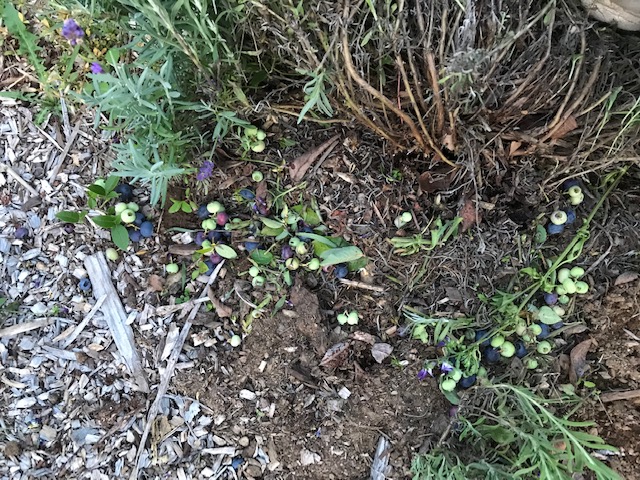
Mice storing sour white berries under the lavender!

I already knew mice just loved blueberries. A few years back, they’d stolen unripe berries right off a bush and made a little cache of them under a nearby lavender plant. There were a few blue and purple berries, but the pile was mostly white ones!

If you raise blueberries, you know they do best with not only frequent watering, but deep. That lavender plant, which you know are very drought-friendly plants, got extremely vigorous from all the extra water.

You may not be surprised to learn that soon afterward, I consigned that bushy lavender hideaway to the weed composting pile. It was too  large to transplant without damaging the nearby blueberry roots.

John, who studied horticulture back in the day, says that the most nutrient-laden portion of a shrub or tree is the layer just under the bark. So those mice were chewing off the bark to get to the really yummy stuff.

(It’s also worth noting that if mice can chew off bark, it’s no big deal to chew holes in the walls of your house.)

Anyway. Now that I knew mice were damaging my shrubs, I used a natural deterrent I’d heard about: garlic. I cut up some old, woody garlic heads left over from the previous season, and scattered the pieces around the crowns of the shrubs.

It worked!

I periodically examined the shrubs for further damage, but it looked like the mice had moved on. If I’d been smart, I would not have moved on too. I would have put some traps in the blueberry patch.

But the growing season was beginning to wind down—and it stopped raining. Nothing to worry about; August is our usual late summer dry spell. I had to let go of weeding and bed-care, and focus on harvesting. And more importantly, watering.

I don’t have any kind of automatic sprinkler-watering system. It’s just me moving hoses. My main hose bib leaks, so I keep a galvanized steel bucket beneath it, emptying it periodically to hand-water separate plants, then empty it again before I go in for the night.

One day I reached for the faucet to turn on the water, and Blecch! There was a dead mouse in the bucket!

I could only guess it had gotten really thirsty. The mouse must have climbed up the house exterior to jump into the bucket for the few remaining drops of water at the bottom.

Well, at least there was one less mouse to make trouble in my garden. And it was time to plant late-summer spinach for overwintering.

So in went the spinach seeds, out came the slug bait, and the up came the seedlings! Spinach takes a bit longer to germinate later in the summer, so I sure was happy to see those sprouts appear.

Than the same thing happened. Seedlings began to disappear in no particular pattern or order. Just like they had with the parsnips.

I replanted, conscious that the window for consistent germination was closing. Fortunately,, the spinach did come up, and I sprinkled more slug bait around the bed, and added more garlic close to the seedlings. But they continued to disappear.

In this hot, dry weather, I'd noticed the slugs were few and far between. Probably slunk off into the woods to stay cool and moist. Still, before long, I had maybe a dozen seedlings left out of 50.

I was really getting frustrated.

Interestingly, about two weeks after the last mouse dead in the bucket, I found another.

The light went off. It was thirsty rodents, making mouse salad from my spinach greens. And they were the culprits that had eaten my parsnips as well.

My biggest mistake was not realizing that these darn mice were taking over our place until they’d done serious damage.

Well, I wasn’t going to let the grass grow under my feet. I still had some old garlic, and did the same drill: cut it up, and sprinkled it among the spinach seedlings.

It had absolutely no effect. Not enough garlic? Or the mice were enjoying their free salads too much to let a little garlic bother them?

I know I’m a bit eccentric, but surely not insane. It was time to make like Einstein and do something different, to get a different result.

I’d learned from a student in my Homestead-Style gardening class that mice loathe peppermint. So I raided my peppermint patches and pots, cut up the leaves and stems and scattered them all around my poor surviving spinach sprouts.

Then for good measure, I set bird netting over the bed. My two-pronged approach worked! The spinach stayed unmolested through the rest of the fall.

But then came the day, shortly before Christmas, that the mice upped their game…

You can read about it in my latest Substack newsletter, just out this week: Home Invasion & A River Runs Through It. 

As a preview, here's a pic! 

Guess Who’s Coming to Dinner!

You don’t have to be a subscriber to read the newsletter—but if you like, you can sign up and have it delivered straight to your inbox.

Now back to mice…any more non-chemical repellents in the garden that have worked for you? I’d love to hear about them!

Thursday, January 5, 2023

Inflation Resolution

Hearty seed bread goes great with nut butter!
Last spring, around the time food costs began to skyrocket, I was busy with planting season… and buying my usual food items without checking the prices. At the grocery checkout, I’d vaguely noticed I was writing bigger checks. 

But didn’t pay much attention until this past summer, when I started checking my receipts once I got home.

Whoa! What an education. The cost of this or that item had noticeably increased: $.25, $.50, and more often than not, by $1.00. Or more! And a dollar here and a dollar there, and pretty soon you’re talking about real money.

When I first noticed that the price of the artisanal whole wheat bread that John and I like (made with locally-milled wheat) had gone up by a dollar, I wasn’t alarmed. I liked my own homemade organic bread even better. 

At the time, we had a whole quart of home-raised honey on hand—a gift from a friend. Since I could be lavish with honey, I vowed to bake my own bread more often.

You can find the recipe in my April 17, 2022 blog post. I like to think my bread is a bit artisanal too, since it’s made with organic, locally-milled whole wheat flour, and the wheat for the white flour is grown and milled just 40 miles away.

Anyway, I had good intentions. Then my garden chores and family responsibities stepped up, and sure enough, we were back to buying the expensive bread without a blink. Once in a while, I would bake a loaf to supplement it, but the purchased bread was once again our mainstay.

Fast-forward to the present: the store-bought bread suddenly went up another dollar. It’s now $9.95. When I saw the receipt, my eyes nearly bugged out of my head. Ten dollars for a loaf of bread!

Well, that kind of spend (on bread that wasn’t even organic) was my personal tipping point.

It was past time to get serious about going homemade. I baked one loaf of bread last Thursday. Then yesterday, we ran out so I started another loaf. Never have I ever baked bread twice in one week!

I slightly tweaked the recipe: cutting down on honey and adding a couple of teaspoons of organic sugar, and a handful of rolled barley to make it a three-grain loaf.

And even if John still likes buying the expensive store-bought bread for variety, I have resolved to personally rely on my own home-baked as much as possible.

Then last night, waiting for the bread to rise, I had a little epiphany: if I was going to go all in with my own bread, the least I should do is find out how much money I was saving…Or if I was really saving much at all.

I checked a recent grocery receipt, a shop when we stocked up on all our baking supplies. The price of white flour was the same it had been all year, but whole wheat bread flour had gone up by about 25%. 

Then in that same receipt, I discovered our usual pint of local honey was up to $15!

I admit, it feels a little insane to spend that much on honey…but here’s my excuse. John and I rarely eat out. So we spend almost all our food budget at the grocery store—and spoil ourselves with really high-quality items.

Still, doing some very rough calculations—and cutting the honey down by half in my recipe—I came up with the approximate cost of my home-baked: about $3 for flours, maybe about a dollar for honey. 

The other ingredients--yeast, olive oil, a spoonful of organic sugar and some salt, and sprinkling of seeds and rolled barley--came to another $1.50, max. The total: around $5.50/loaf.

Last night, I told John about computing the cost of my homemade bread—and he asked me a surprising question: “So, did you factor in your time?”

“I actually didn’t,” I confessed. It’s true, the whole process takes at least a couple of hours, mixing and kneading and baking and cleaning up. Which then brings up the question: what is your time worth?

If you’re self-employed, like me, it gets complicated, doesn’t it? Especially if you spend lots of time growing food, like I do, instead of working on your business. And John is really good about helping me protect my writing time. 

But I realized something else. It’s not only about money. The mini-mediation break I get while kneading dough, and the pleasure of eating such delicious and good-for-you bread more than offsets the time I spend on it.

And while we don’t make special trips into civilization just to buy bread, we do save time and gas not having to drive to the bakery when we are in the city.

In any event, I can make a delicious, organic loaf using many local ingredients for almost half the cost of high-quality purchased bread. Food prices being what they are—always going up and never down—I plan to make this resolution stick!