Wednesday, April 27, 2022

Spring Garden Planning & Inflation Shocker

Garden Map 2022
Spring planting time in the Foothills has finally arrived, and just in time, I’ve created an updated garden map for 2022. Although spatial orientation is not my strong suit, and I can’t draw worth a darn, I took a stab at it—if only to show that even a rough map can work!

In any event, mapping your garden is a super-easy way to track your crops for rotation and soil amending. 

Years ago, I got the idea of mapping your garden from the manager of our local nursery—but didn’t draw my first map until last year! Now, I don’t know how I ever did without one. 

Being able to clearly see (and not have to rely on my often unreliable memory) what crops have been planted where in the last 4 or 5 years is already helping my efficiency in the garden.

Also, with a lot of family things going on the last 9 months, having my garden map helps prevent the sort of mild paralysis I’ve been having over all the decisions a food gardener has to make at planting time. 

For instance, at the end of April and early May, I’ve got 6 or 7 beds to sow—and I tend to keep second-guessing myself until I actually get the darn seeds in the ground, and it’s too late to do anything about it!

When I get overwhelmed by garden chores, my husband John always gives me the same advice: just pick one job and work on that. 

Having a map, I’m learning to apply the same suggestion to deciding what crop to plant in what location. If you’ve got a map, just take things one bed at a time. Select your bed, assess what you’ve planted there previously, then make your choice from your collection of seeds that hopefully you’ve purchased by now!

Price Surprise: Like you probably are, I’ve been tracking the prices of our usual food purchases and household items. The seeds we buy from a local seed grower haven’t gone up in price—but oh my gosh, did I get an inflation shocker: the new 40 lb. sack of organic, locally-made layer mix we feed the hens skyrocketed by $7. In 2 months, it went from $35.99 to $42.99. Just last summer, the price was $32.99.

Ouch!

A few months back, I did a post on the economics of keeping a home flock of laying hens. My conclusion back then: let’s just say don’t expect to save any money on home-grown eggs. With this latest price increase, our home flock seems to be even more like a hobby—and expensive one at that. 

However you look at it, self-reliance doesn’t always come cheap! 


Thursday, April 21, 2022

Recipe for Hearty Seed Bread

Low-knead hearty bread
If there was an invention you wish were real, what would it be?

I didn’t come up with this question—it was recently posed to a science fiction writer in a interview. But it's an intriguing one, don't  you think? For me, having a gizmo that instantly weeds my garden sounds pretty fantastic. 

But my answer is the same as this writer’s: she’d like an invention that will let her summon any dish she craves at any time.

Happily for me, the dishes I like best are the ones I make myself! And one I’m particularly fond of is my own organic whole grain bread.

I know, home-baked bread is so 2020. But this is an easy recipe, and so very delicious.

Also, if you prefer specialty breads (as opposed to bread from a factory) this one is more affordable! One of our indulgences is whole grain bread at a local artisanal bakery--but I discovered today that the price of our favorite bread just went up $1 per loaf. So I know that a) with homemade bread, we are definitely saving money, and b) I'll be making this bread far more often!

I got the idea for this recipe from one a friend shared for no-knead, rise-in-the-fridge bread. The orginal recipe indicated you could substitute 1/3 of the flour with whole wheat and it would work fine.

Well, I'm not so sure. I don’t really care for white bread, so I used more of a flour ratio of  2/3 whole wheat to 1/3 white flour. The organic whole wheat bread flour our local Co-op carries is very coarse, so it makes a fairly heavy dough. Plus for this experimental loaf I added seeds, which added even more weight to the dough.

What I learned was that breads with lots of whole grain flour need at least minimal kneading.

So I came up with my own take: Hearty “Low-Knead” Seed Bread.

Ingredient list:  

1 ½ cup very warm water

1 teaspoon yeast

1 teaspoon honey (local if you can get it)

1 heaping cup organic white flour

2 Tablespoons olive oil

¼ cup additional honey (again, local if possible)

½ heaping cup organic white flour

½ cup organic whole wheat pastry flour

2 cups organic whole wheat bread flour

¼ cup organic stone-ground cornmeal

1 teaspoon sea salt

(Plus more flour for kneading)

2 Tablespoons sesame seeds

3-4 Tablespoons organic sunflower seeds 

Yep, it’s a lot of honey, and honey can be expensive. A friend gave us a giant jar of honey from his own hives, so I can be lavish until it’s gone! Otherwise, I might use just a few spoonfuls of honey, plus some organic sugar. Keep in mind that skimping on sweetening, this bread will be a little too tangy.

Okay, on to the process:

Combine the water, yeast and the 1 teaspoon of honey and stir until the yeast dissolves.

Let it sit for 5 or 10 minutes until you get bubbles forming. Then add the heaping cup organic white flour and mix until most of the lumps of flour have dissolved.

Sponge is ready!
I cover the bowl with a clean towel and let it sit on the kitchen counter for at least a couple of hours.

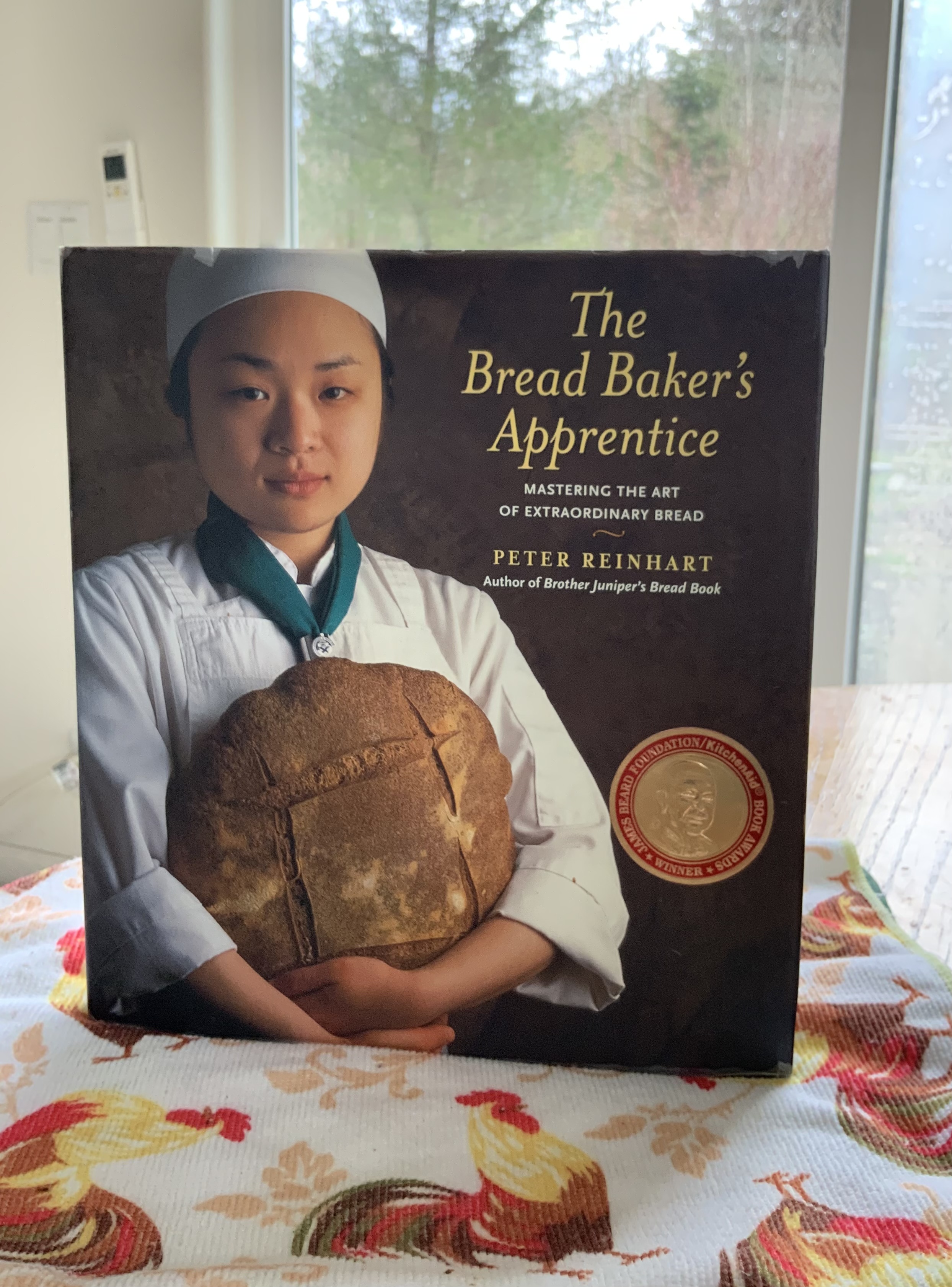
This creates what’s called a “sponge,” an idea I got from the book The Bread Baker’s Apprentice: Mastering the Art of Extraordinary Bread by Peter Reinhart. 

As I understand it, instead of mixing all your wet and dry ingredients together in one fell swoop, this step of proofing the yeast gets the gluten developing, and gives a running start to the rising process.

Great bread-baking tips

Also, I’d read that adding salt to the yeast at the same time can inhibit the rising, so I add salt later.

Okay, once your sponge is nice and bubbly, stir in the olive oil and the additional honey.  

In a separate bowl, mix the dry ingredients and combine thoroughly: flours, salt, and seeds. Add to the liquid ingredients in stages and mix well. Add more flour as needed so the dough isn’t too sticky for kneading. 

Sprinkle more flour on the countertop (white or whole wheat, your choice), remove the dough from the bowl and start kneading!

Add more flour as you knead, to keep the dough from sticking to the counter.

I have been known to knead bread dough for upwards of 20 minutes. But this recipe, I knead for about 7 minutes, until the dough starts to feel somewhat pliable.  Then I grease the bowl with more olive oil and plop the dough back in.

I cover the bowl with the same cloth, put it in a reasonably clean plastic bag and stick it in into the fridge.

You can let the dough do its slow rise overnight, or if the next day will be a busy one, it won’t hurt the dough at all to sit in the fridge 2 nights. More time will only increase the flavor!

Baking day, remove the dough from the fridge and let sit at room temperature at least 3 hours. (Our house is sort of chilly so the dough needs more like 4 or 5 hours).

When the dough has warmed to room temperature, give it another quick kneading, then form your loaf, and place in a buttered bread pan. (I use glass.)

Let your loaf rise in a warm location: this will take at least 2 ½ to 3 hours—like I said, all the whole grain flour and seeds add a lot of weight. When the loaf has risen to your liking, place in a pre-heated oven at 350 degrees on the lower-middle rack (so the top doesn’t brown too much).

I bake the bread for 20 minutes, then turn the pan around for even browning and bake for another 15 minutes. By now, the top is browned but the loaf inside the pan is still pretty light.

I loosely cover the top with a strip of aluminum foil, then bake the bread for another 10 minutes or so.

When it’s nicely browned and looks ready, out comes the pan and I set it on a cooling rack for a couple of minutes. Then I remove the loaf and let it cool directly on the rack. It can take a couple of hours until the bread is ready for slicing—but keep in mind, the longer you wait, the more the flavors develop.

There you have it: this hearty bread takes a bit of patience--but keep in mind, all the stages of making the sponge, fridge time, warming the dough, and rising time means you can space out the time needed for prep. It goes without saying that this bread is scrumptious! It also freezes well!


Thursday, April 14, 2022

Author Jenny Colgan and Public Library Love

This week’s public library treasures!
Part of the “homesteady” lifestyle, to my thinking, is being thrifty.

And that includes one’s reading habits. As much as I would LOVE to support our local independent bookstore and treat myself to the latest releases from my favorite authors—or even buy books that simply catch my interest—I’m a library girl.

I wasn’t always—when my daughters were young wanted to go to the mall, I used to have weekly splurges at B. Dalton. But life has changed.

Since moving out here to the Foothills, and a much smaller house, I just don’t have the room for more books—our bookshelves, as well as every nook and cranny, is stuffed to the gills already! My husband John is a huge reader, and what he couldn’t fit in the house he stored in our shop/garage. 

A shop with LOTS of mice living in it. Mice will chew a book to bits—and did.

You may ask, what about ebooks? They don’t take up any physical room.

You’re absolutely right. The thing is, the only time I have for pleasure reading is at night, after dinner and doing the dishes. However, I’m very sensitive to the blue light of digital devices, and even glancing at a screen any time after 8:30 will literally keep me awake until 6 am. 

Which leads me to my other reason: I don’t have the wiggle room in my budget to purchase 2-4 books every month. Last time I checked, print books were around $16 for your standard paperback and around $27 for a new hardback. Ouch.

True, ebooks are less expensive, but then, I’m back to my nighttime screen problem. 

Anyway, when a Christmas book by my favorite author, Jenny Colgan, comes out in November, I always put it on hold—and since she’s very popular, I often have to wait until early spring to read it. But that’s okay. Her warm, and life-affirming stories, full of endearing characters, and all about family and falling in love, are worth waiting for! 

Finishing Jenny’s latest holiday book this week turned out to be sort of timely: it snowed!

You can put in a request for any of Jenny Colgan’s books at your neighborhood public library—and it applies to pretty much any current title you’re hankering for. 

And if you’re interested in my books, my homesteading memoirs are available in paperback and ebook by request at your local library, and all my novels are available by request too, in ebook format! 

Thursday, April 7, 2022

Coyote is Back—No, Wait, It’s a Bobcat!

Hens a bit agitated after their scare
This was a first.

When it comes to wildlife incursions at our place, I thought I’d seen it all. But other day, as sundown approached, the hens were making some weird sounds—not their usual buck-buck- bucking alarm call, but one I hadn’t heard before: strange, high-pitched shrieking.

I jumped to the window to see a hen flying off the big maple stump, still screeching—and a large, dark shape hovering over the girls’ caged pen: a critter had climbed up the steer wire fence and was terrorizing the girls only a few feet away from them.  ON TOP of the pen.

I ran outside and the dark shape slunk the woods—but as it jumped over our fence about 40 feet away, I saw the black streak on its tail. A coyote.

At least the girls were physically safe in their caged pen. As they changed to their buck-buck alarm call, I called out to them, over and over, “It’s okay, it’s gone, you’re safe.”  

As the two hens gradually dialed down their alarm, I returned to the house, sighing, and changed into my work gear. After the encounter with a killer, the girls would probably retreat back to the coop, lose interest in eating, and stop laying for a while. Again.

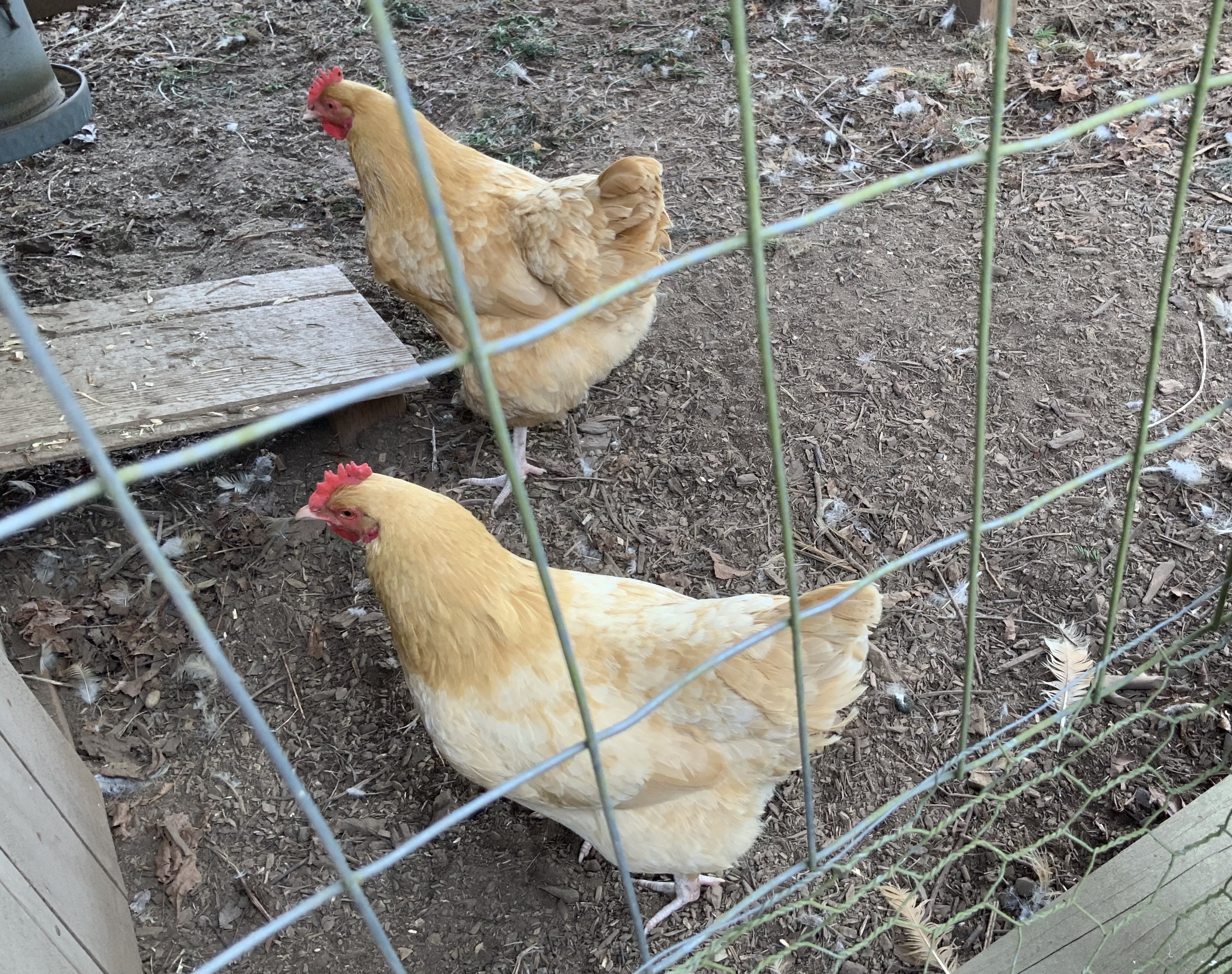
I was wrong. Even though they’d recently been traumatized from the hawk attack that killed their “sister,” these two girls proved to be very resilient. They didn’t run to coop, just sort of loitered around the pen, and after a little while, pecked at their feeder. They seemed to have good appetites when I refilled it too.

The next morning, they were out as usual, roosting on the big stump. And the biggest surprise: two eggs in the nest! And since then, they’ve been laying better than ever.

But now that I know for sure the coyote(s) aren’t giving up, I can’t pretend that keeping the girls in their cage all day is only temporary. (Though I was really secretly hoping it was.)

It’s true, the cage is pretty good for hens' digs: it’s about 20’ x 10’, plenty roomy for at least a half-dozen chickens, so the two of them have plenty of space. And the big-leaf maple stump serves as a hen jungle-gym of sorts, and has become a favorite roosting spot. Plus now that it’s weeding season, I frequently toss a bunch of pulled weeds in the pen for them to scratch through.

But still. With predators from the ground and from the sky, these incidents will keep happening. Just yesterday afternoon, as I was leaving for a bike ride, I heard the girls’ alarm call again. I jumped off my bike and hurried to their cage.

One girl was looking very vigilant, neck stiff, peering around, and the other was inside the coop. Maybe the coyote had paid another call—but the one hen must’ve known she was safe. And when I returned, both girls were milling around as usual. Maybe they’re actually getting used to being hassled!

Later that afternoon, I did let them out into their fenced yard while I did some weeding. They seemed to enjoy scratching in the new spring grass, but seeing them out in the open was nerve-wracking for me. A hawk could descend on a hen in seconds, a coyote climb a fence and snatch one just as quickly. I breathed a sigh of relief when they went inside for the night.

If you’re a regular reader of this blog, you know it was coyotes that killed our last flock of five hens. And over the last couple of months, coyotes have been picking off our neighbor’s chickens too.

Update 3 hours later…

I was heading for the coop, skirting past one of our woodsheds when I heard a thump, and a rustle: just feet away, a large, tawny shape leaped through the shed and streaked away. A bobcat! It was clearly stalking our hens again.

It was the tail that fooled me. I hadn’t seen a bobcat for a year or so and had forgotten their tails are simply shorter than a house cat’s, not completely bobbed. And this creature had a black streak on its tail. So it was a bobcat’s tail I saw as it jumped our fence, a bobcat that was after the hens this week, just like it’s a bobcat that’s been killing our neighbor’s chickens. 

We’re almost certain coyotes killed our flock, but I guess the whole climbing coyote thing was my imagination going into overdrive. 

In any event, it doesn’t matter: coyote or bobcat, they still want to eat our hens. Nature, I am forced to conclude, is relentless. As much as we humans think we can control or outsmart the weather or wildlife, or nature will win every time.

But what’s interesting and sort of sad: since the hawk attack, the girls been turning into their coop much earlier. Hens have sort of a light sensor in their brain structure—a gland—which cues them when the daylight starts to dim prior to sunset. And that’s when hens generally go into their coop for the night.

The hawk attack happened a little while before this change in light. And ever since that early evening, our two girls have been turning in significantly earlier than they used to: a good 45 minutes before sundown. And although they’ve returned to their other normal hen behaviors, I’m guessing that terrible incident imprinted on their brains for the long term.

On a more hopeful note: If you’re interested in the way hens brains work, here’s a charming little book written by a true chicken-lover:   How to Speak Chicken by Melissa Caughey. It’s a fun and quick read, with some fascinating intel about roosters too. The author shows that hens are FAR more intelligent than folks give them credit for, and far more than most humans have ever suspected. 

Super-interesting book!

For lots more chicken-keeping tips, info and stories, you might check out my 2021 posts, here on the Little Farm blog!


Thursday, March 31, 2022

Inflation Woes & Grow Your Own

Great resource for food gardeners
We’ve all been hearing about food prices going up. But when I looked at my grocery co-op sales receipt yesterday, I saw the head of lettuce I’d purchased had gone up a buck! I mean, in just a few weeks, the price hadn’t increased by 25 cents or 50–but an entire dollar in one fell swoop.

My first thought was, I’m sure glad food growing season is starting. My second was, it’s time to get busy!

Although I’ve written a gardening guide, I’m always happy to come across new information and gardening insights. So I heartily recommend “Mini-Farming: Self-Sufficiency on 1/4 Acre,” a gift from John’s daughter. It’s loaded with detailed tips and techniques to increase your food-growing productivity and efficiency. 

Some examples of tips I found especially helpful:

*Use only vegetable-based compost for carrots. Composted manure may work well for many crops, but can make carrots bitter.

*When creating a new bed, dig the soil deeply, as much as 2 feet! That way, your crop can access more nutrients and moisture from the soil and subsoil. 

* Adding lots of compost to your soil every year will build that soil over time, with the same healthy-plant benefits as deep-digging.

*Trellised varieties of vegetables are more productive than bush types—this way, the plant gets more of a 3-D benefit from more light and room. 

The author runs some numbers regarding how much money you can save by growing your own produce, but it’s way outdated: the book was published in 2009, and we all know how much food costs have exploded since then! Still, the book does give you an idea of the economic benefits, and at the same time, shows the many, many advantages of growing as much food as you can.

I just learned that next week, April 3-9, is National Library Week! You just might be able to find Mini-Farming at your local public library—lots of public libraries will let you make a request for any title too. I have a handy list of more gardening resources at the back of my gardening guide, Little Farm in the Garden!


Wednesday, March 23, 2022

Hens' Recovery


Hens being hens again!
I thought they would stay in their coop forever.

After a red-tailed hawk killed one of our three hens (see February 24 post) the remaining two spent their days huddled in the coop, hardly eating or drinking.

The girls were obviously very traumatized. They’d not only stopped laying eggs, they had stopped acting like hens.

It seemed like they were fading away…and I was afraid they would eventually succumb to starvation.

After 10 days, the hens began leaving the coop just once or twice a day for a few minutes and peck listlessly at their feeder, like they’d lost their appetites. They wouldn’t even go on the side of the pen closest to their yard—and certainly nowhere near the pen door, several feet from where the other hen had died.

Even when John and I visited their pen, to coax them out into the world again, they weren’t interested. Then the day came when, accompanied by John and me, the two hens very slowly ventured into their yard.

They pecked at a few blades of grass—but eating like they had before: a couple of pecks, then lifting their heads to look around.

Clearly, the girls still didn’t feel safe. I wondered if they’d eat and explore the way they used to. And if they'd ever lay eggs again.

They still weren’t engaging in normal hen behavior: taking dust baths or scratching. I decided, let’s mix things up a little—shake the girls out of this funk!

Next to their yard, there’s a narrow area between the outside of their fence and one of our woodsheds. It’s chock full of weeds and big clumps of grass. I figured, surely in such a confined space, they could let down their guard. And if that juicy green grass doesn’t get them scratching, nothing will.

So John and I herded them into this small space, closed them in with a length of steer wire, and hovered again. They did seem to like the grass, and gave it a few pecks. Then they wanted OUT.

“Girls, give it a chance,” I coaxed them. “Just a few more minutes?”

Oh, no. The girls continued to pace the short length of wire, making distressed sounds. I didn’t want them to get re-traumatized, so John and I let them out. They made a beeline for the coop.

I said to John, "I guess our experiment failed." 

Or had it?

The next few days, the two girls began to spend more time outside the coop. When I came into the pen to feed them, I could tell they’d been eating more. Then one day, I saw signs they’d been dust bathing! 

The next day, when I came to see them, the hens ventured into their yard without too much coaxing. They pecked at some grass, and actually started to scratch a little. Yay! They were finally back on track!

Then…a large bird flew over our place.

Immediately, they looked skyward, then the bird made a Caw. Those girls scuttled right back into the pen. "C’mon girls," I told them, "it’s only a raven, you’re okay. It’s not even that close!" But they wouldn’t come out again.

Another day or two went by, and the girls were starting to spend most of their days in their pen. Not in the coop. I could see more signs of dust-bathing. And they had found their appetites again. John and I gave them another chance to come out into the yard, and they pecked at the dirt and even scratched a little.

Then, low and behold, three weeks and a day since the attack, I found an egg in one of the nests!

Since that first egg, nine days ago, the girls seem eager to get out in their yard again. They’re scratching with gusto, and even climbing up on the old maple stump—all happy hen behaviors. And judging from all the droppings in their pen, they eating normally again. Maybe making up for lost time.

And we’ve gotten five more eggs!

We still can’t let the hens out in their yard unsupervised. The hawk attack came without warning—the big raptor hadn’t first made an exploratory pass over the yard or anything. Just boom!—attack. So John and I can’t trust this bird won’t try again.

I regret the girls can’t go back to free-ranging all day, and get the light and scratching time they need, which makes them happy.

Still, for me, this experience was a lesson in hen-keeping. Our girls, it seemed, needed to recover in their own good time. Not according to humans’ timeframe or expectations.

It’s how nature works, isn’t it? Everything happens when the time is right…and not before. By the way, Happy Spring!


Wednesday, March 16, 2022

Irish Novel on Sale + "Behind the Scenes" Look!

Warmhearted Irish novel
My Irish love story, Becoming Emma, has been selected for a special Women's Fiction Sale on Kobo starting today! 

The sale pricing applies to Kobo's UK, Australia, and New Zealand regions—and is also available on Amazon UK and AUApple, and other ebook retailers!    

While this blog is mostly about gardening and homesteady stuff, here’s a little of what I do when I’m not working around our place…

Behind the Scenes...

Becoming Emma follows Dublin girl Emma Carey's search for love and home and family in the most unlikely of places. One of the story events is actually is a big St. Patrick’s Day party...so I thought I'd share a brief look at how the story came about.

Although much of this novel takes place in a new locale near Seattle, Washington, another big part of Becoming Emma takes place in the village of Ballydara, my fiction series set in County Galway, Ireland.

My Irish stories are set in a rural area that’s been inspired by a few other places, real and imaginary. As a country-dweller who lives in a somewhat remote area, several miles from a tiny town nestled in fir-covered foothills, I incorporated my favorite elements of my true-life, local village into my fictional Galway setting—for example, the beautiful scenery where I live and the fact that there’s no mobile signal or high-speed internet. 

I also invented an Irish version of our village: both have a small shop, a church, and of course, a pub, where, as they say, “everybody knows your name.”

In creating Ballydara, I also drew a bit of inspiration from two beloved BBC series: Ballykissangel, set in a little Irish community, and Doc Martin, which takes place in another picturesque locale in the British Isles, on the coast of Cornwall. Hopefully, the residents of Ballydara are as endearing as the television characters, but not quite so daffy!

It’s funny, how one’s fictional characters and story worlds evolve. I began a novel about my Emma character and her love interest Declan O’Donoghue years ago, with a different title. But the story just didn’t come together the way I wanted it to and I put it aside.

As a few years passed, Declan’s family became so clear in my mind I wrote two “novelette-length” short stories about them--the first from his dad Frank’s point of view, The Secret Well. The second story, The Christmas Visitor, is from his mother Maeve’s point of view. But it was Hazel, Emma’s mysterious sister, who changed Maeve and her family.

Both stories were deeply entwined with the bigger story about Declan and Emma, still waiting to be written.

 I was still scribbling little bits and bobs about Declan and Emma, even a chapter here and there, but I still wasn’t ready to get going on their story. I went on to write two other Ballydara books, The Hopeful Romantic and The Galway Girls.

Then the time came when Emma and Declan insisted that I tell their story—and Hazel’s too. As I finished a huge, rambling draft of a novel, titled Becoming Emma, I had an epiphany: this very long book was actually two novels—at around 800 pages, it was just too much story for one book. 

Then for a fun, summertime project, I wrote a prequel about Emma, before she met Declan, The Little Irish Gift Shop—and all three novels became The Fairy Cottage Mini-series. I went on to publish Becoming Emma, then...

I ended up releasing a Special Edition of Becoming Emma, which includes the two connected short stories The Secret Well and The Christmas Visitor in the correct reading order. The second part of this big story, The Fairy Cottage of Ballydara is the sequel to Becoming Emma, and will be out this spring!

If you celebrate St. Patrick’s Day, I hope you’re enjoying your Irish festivities... Just for fun, here's a couple of pics from our trip to Ireland a few years ago. You can find more about my Irish novels and my homesteading too, at www.susancolleenbrowne.com!

John and I at St. Patrick's Mountain, County Mayo

A wee traveling cart in Dingle, County Kerry