Thursday, January 26, 2023

Mighty Mice

“’Twas the week before Christmas and all through the house

Not a creature was stirring, not even a mouse…”

Well, that’s not the way things went down at our place. 

In my last mouse post, I mentioned those destructive little buggers--who had eaten their way through my spinach bed this fall--had really stepped up their game. And did they ever! But let’s start at the beginning…

My favorite cartoon when I was a kiddo was “Mighty Mouse,” featuring a muscular, take-charge rodent wearing Superman-like togs. This mouse righted wrongs, and always got the bad guy. (My enjoyment in Mighty Mouse’s exploits was pretty predictable: I was a mousy, underweight child, perennially bossed around by my older sister.)

But there’s where my mouse fandom ends.  

I’m as revolted by rodents as the next person—although I’ve learned that living in the country means that mice are inescapable. My most memorable mouse encounter was back in the day, which I relate in my memoir Little Farm in the Foothills.

For a couple of months, my then-husband, my baby and I lived in a drafty old mobile home in the middle of a dairy farm. When we moved in, nearly every horizontal surface was sprinkled with mouse droppings.

You’d think that would have been my first clue, to store all my food in mouse-proof containers.

But what did I know? I was a city girl. Anyway, one chilly December evening I opened my kitchen cupboard, filled with food wrapped in plastic—and caught a mouse by surprise. It jumped on me and ran down my leg!

Let me tell you, there was some shrieking—and I felt that sensation on my leg for years.

Fast forward to present day: my husband John and I will soon celebrate 17 years living in the Foothills. All this time—save for discovering some mouse droppings under the bathroom sink many years ago—all our mouse incursions have been outside the house.

These little critters, their droppings, and their nests are pretty much everywhere: in our shop, the woodsheds, and the carport, in every corner, cranny, and hidey hole.

A straw bale in the chicken coop shed once made for a very hospitable mouse abode, judging from the day I was fetching some feed and a mouse jumped out of the straw and dived into my muck boot. You can bet I tore off that boot and flung it away.

The sensation of a mouse wiggling against the top of my foot was one I also felt for years.

Mice have even invaded our car engine, finding their way to the air filter, which they chewed for nesting material. But let me stress: all those mice were outside.

So, just like I had been lo, those many years ago, I was confident our house was mouse-proof. That being the case, we stored lots of food stored flimsy plastic bags. And one week before Christmas, after stocking up on holiday items, the pantry was filled to the brim.

John and I had just arrived home, weary after a seven-hour drive from my daughter’s house. We trudged through the icy pathway to our house, schlepping my suitcase and totes and the bags of groceries we’d bought before the last leg of our trip.

I was trying to figure out how to stuff more groceries into our already-full pantry when I saw something on the lowest shelf.

A small dark flash, then a tail. It streaked out of sight.

My heart stopped. “Oh, s&%#!” I scrambled backward before the mouse could jump on me. “John!” I yelled. “There’s a mouse in the pantry!”

Running over from the living room, he said incredulously, “A mouse?”

We both peered into pantry. “I don’t see anything,” said John, cautiously moving pantry items out of the way. 

I kept my eyes peeled, but I didn’t see anything either. For a second, I felt ridiculous. Had the mouse been a figment of my tired imagination?

“Maybe it was a salamander,” I ventured. In my mind’s eye, I could still see the intruder’s dark-gray skinny tail. I’d seen plenty of salamanders in the rocks bordering the shop, and inside it too. And this critter definitely had a skinny, potentially salamander-ish tail.

Okay, I was doing my Pollyanna thing again—trying to think positive. Still, we had never, ever had mice in our kitchen.

As John cleared more pantry space (I didn’t have the courage to do it, afraid of the mouse-down-the-leg replay), I couldn’t delude myself. Behind every plastic-wrapped food item were tiny, tell-tale (tell-tail?) tiny black bits, unmistakable against the white pantry shelves.

Mouse evidence in my pantry!
Mouse droppings. My heart sank all the way to my dog-tired toes.

What now? I hoped our presence had scared the mouse enough to sneak back to wherever it had come from and leave us alone.

But I knew one thing: I wasn’t going to put any more groceries in my contaminated pantry! I stuck them back in their paper bags and left the bags in the middle of the kitchen floor. 

Surely no rodent would be bold enough to cross the floor right under our feet!


To be continued.... 

I'll post the rest of the story next week here at the Little Farm in the Foothills blog. Or, you can find the full post right now in my latest Little Farm Writer Substack

My Substack newsletter is open to everyone, so you don't have to subscribe to read it. But if you join, you can get every issue delivered the 10th of each month directly to your email inbox!  

Friday, January 20, 2023

Irish Novel on Sale!

Are you dreaming of spring yet? And enjoy warmhearted love stories set in the country, with chickens and gardening in the mix?

Then you might like my tender Irish novel The Galway Girls—which Kobo Books has selected for their 25% off January promotion! The story follows Kerry and Fiona, two Irish thirtysomething friends, as they search for their heart’s desire in the misty green hills of County Galway. 

For Kerry, it’s a second chance with the love of her life; for Fiona, a surprising romance with a younger man. You’ll find more information at SusanColleenBrowne.com.

Or you can check out The Galway Girls at Kobo’s 25% Off January Sale! Just scroll down to the Fiction carrousel. The sale goes through January 30, and the promo code is 25JAN. 

While you wait for warmer weather, I hope you’re enjoying winter gardening, deep diving into seed catalogs, and reading great books!

Thursday, January 12, 2023

Mystery Afoot at the Little Farm

You know how sometimes you don’t realize you’ve got a problem, until it’s almost too late to solve it?

Taking advantage of the winter lull in our garden, I’ve been looking back on this past growing season. While it’s always fun to reflect on John’s and my successes, what stands out are all the wrong turns I made. Especially in one area.

The evidence about the problem was right in front of me, but as I often do, I ignored it. Hoped I was wrong. And paid the price.

I first noticed an issue in my parsnip bed. I planted two rows instead of my usual three, since I’d overplanted last year. I didn’t want a repeat of having too many ’snips to harvest between freezing cycles, and tossing out so many, after the roots had become too woody to eat.

As soon as the tiny seedlets emerged, I looked at the bed in dismay. That’s not many parsnips! I ended up planting a third row after all.

Smartly (I thought), I surrounded the bed with organic garden-friendly slug bait.

The seeds germinated, the first teeny, oblong leaves unfolded. Then disappeared.

Grrr—those were some aggressive slugs, getting past the bait! But slugs being slugs, they are ruthless about devouring seedlings. Luckily, it wasn’t too late to replant. 

Parsnip seeds can take weeks to germinate. I watched the bed eagerly, delighted when this next row emerged. Then one by one, here and there, the seedlings once again disappeared.

Now, I was getting mad. I put out more slug bait, and planted yet one more time.

Same result. You know that classic definition of insanity, about doing the same thing and expecting a different result? (Albert Einstein.) And it was too late in the season to replant, so I wasn’t going to do a dumb thing like sow even more seeds.

The odd thing was, the parsnip seedlings had disappeared sort of sporadically. One or two would be  eaten, the others untouched. Then a day or two later, a few more would be gone, at a different spot in the bed.

In my experience, slugs will sort of pick a spot in your seedlings, and in one night, mow down 1/3 of a row in one fell swoop. They don’t waste time picking and choosing, leaving food right in front of their horrible sluggy faces.

But I had better things to do than figure out weird slug eating habits. I’d have to be content with the surviving parsnips.

Along came midsummer. I was spending more time in the blueberry patches, which need weekly watering. Placing the sprinkler near the base of one of my most reliably productive shrub, I noticed the bark. Actually, the bark that wasn’t there.

Looking closer I saw gnaw marks. Hoo-kay. The mice were at it again.

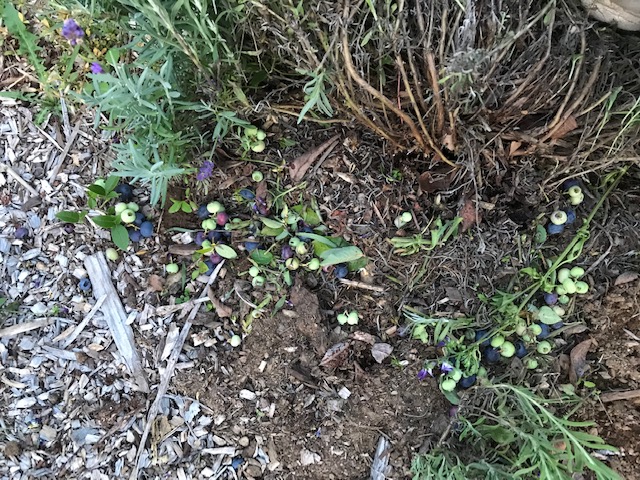
Mice storing sour white berries under the lavender!

I already knew mice just loved blueberries. A few years back, they’d stolen unripe berries right off a bush and made a little cache of them under a nearby lavender plant. There were a few blue and purple berries, but the pile was mostly white ones!

If you raise blueberries, you know they do best with not only frequent watering, but deep. That lavender plant, which you know are very drought-friendly plants, got extremely vigorous from all the extra water.

You may not be surprised to learn that soon afterward, I consigned that bushy lavender hideaway to the weed composting pile. It was too  large to transplant without damaging the nearby blueberry roots.

John, who studied horticulture back in the day, says that the most nutrient-laden portion of a shrub or tree is the layer just under the bark. So those mice were chewing off the bark to get to the really yummy stuff.

(It’s also worth noting that if mice can chew off bark, it’s no big deal to chew holes in the walls of your house.)

Anyway. Now that I knew mice were damaging my shrubs, I used a natural deterrent I’d heard about: garlic. I cut up some old, woody garlic heads left over from the previous season, and scattered the pieces around the crowns of the shrubs.

It worked!

I periodically examined the shrubs for further damage, but it looked like the mice had moved on. If I’d been smart, I would not have moved on too. I would have put some traps in the blueberry patch.

But the growing season was beginning to wind down—and it stopped raining. Nothing to worry about; August is our usual late summer dry spell. I had to let go of weeding and bed-care, and focus on harvesting. And more importantly, watering.

I don’t have any kind of automatic sprinkler-watering system. It’s just me moving hoses. My main hose bib leaks, so I keep a galvanized steel bucket beneath it, emptying it periodically to hand-water separate plants, then empty it again before I go in for the night.

One day I reached for the faucet to turn on the water, and Blecch! There was a dead mouse in the bucket!

I could only guess it had gotten really thirsty. The mouse must have climbed up the house exterior to jump into the bucket for the few remaining drops of water at the bottom.

Well, at least there was one less mouse to make trouble in my garden. And it was time to plant late-summer spinach for overwintering.

So in went the spinach seeds, out came the slug bait, and the up came the seedlings! Spinach takes a bit longer to germinate later in the summer, so I sure was happy to see those sprouts appear.

Than the same thing happened. Seedlings began to disappear in no particular pattern or order. Just like they had with the parsnips.

I replanted, conscious that the window for consistent germination was closing. Fortunately,, the spinach did come up, and I sprinkled more slug bait around the bed, and added more garlic close to the seedlings. But they continued to disappear.

In this hot, dry weather, I'd noticed the slugs were few and far between. Probably slunk off into the woods to stay cool and moist. Still, before long, I had maybe a dozen seedlings left out of 50.

I was really getting frustrated.

Interestingly, about two weeks after the last mouse dead in the bucket, I found another.

The light went off. It was thirsty rodents, making mouse salad from my spinach greens. And they were the culprits that had eaten my parsnips as well.

My biggest mistake was not realizing that these darn mice were taking over our place until they’d done serious damage.

Well, I wasn’t going to let the grass grow under my feet. I still had some old garlic, and did the same drill: cut it up, and sprinkled it among the spinach seedlings.

It had absolutely no effect. Not enough garlic? Or the mice were enjoying their free salads too much to let a little garlic bother them?

I know I’m a bit eccentric, but surely not insane. It was time to make like Einstein and do something different, to get a different result.

I’d learned from a student in my Homestead-Style gardening class that mice loathe peppermint. So I raided my peppermint patches and pots, cut up the leaves and stems and scattered them all around my poor surviving spinach sprouts.

Then for good measure, I set bird netting over the bed. My two-pronged approach worked! The spinach stayed unmolested through the rest of the fall.

But then came the day, shortly before Christmas, that the mice upped their game…

You can read about it in my latest Substack newsletter, just out this week: Home Invasion & A River Runs Through It. 

As a preview, here's a pic! 

Guess Who’s Coming to Dinner!

You don’t have to be a subscriber to read the newsletter—but if you like, you can sign up and have it delivered straight to your inbox.

Now back to mice…any more non-chemical repellents in the garden that have worked for you? I’d love to hear about them!

Thursday, January 5, 2023

Inflation Resolution

Hearty seed bread goes great with nut butter!
Last spring, around the time food costs began to skyrocket, I was busy with planting season… and buying my usual food items without checking the prices. At the grocery checkout, I’d vaguely noticed I was writing bigger checks. 

But didn’t pay much attention until this past summer, when I started checking my receipts once I got home.

Whoa! What an education. The cost of this or that item had noticeably increased: $.25, $.50, and more often than not, by $1.00. Or more! And a dollar here and a dollar there, and pretty soon you’re talking about real money.

When I first noticed that the price of the artisanal whole wheat bread that John and I like (made with locally-milled wheat) had gone up by a dollar, I wasn’t alarmed. I liked my own homemade organic bread even better. 

At the time, we had a whole quart of home-raised honey on hand—a gift from a friend. Since I could be lavish with honey, I vowed to bake my own bread more often.

You can find the recipe in my April 17, 2022 blog post. I like to think my bread is a bit artisanal too, since it’s made with organic, locally-milled whole wheat flour, and the wheat for the white flour is grown and milled just 40 miles away.

Anyway, I had good intentions. Then my garden chores and family responsibities stepped up, and sure enough, we were back to buying the expensive bread without a blink. Once in a while, I would bake a loaf to supplement it, but the purchased bread was once again our mainstay.

Fast-forward to the present: the store-bought bread suddenly went up another dollar. It’s now $9.95. When I saw the receipt, my eyes nearly bugged out of my head. Ten dollars for a loaf of bread!

Well, that kind of spend (on bread that wasn’t even organic) was my personal tipping point.

It was past time to get serious about going homemade. I baked one loaf of bread last Thursday. Then yesterday, we ran out so I started another loaf. Never have I ever baked bread twice in one week!

I slightly tweaked the recipe: cutting down on honey and adding a couple of teaspoons of organic sugar, and a handful of rolled barley to make it a three-grain loaf.

And even if John still likes buying the expensive store-bought bread for variety, I have resolved to personally rely on my own home-baked as much as possible.

Then last night, waiting for the bread to rise, I had a little epiphany: if I was going to go all in with my own bread, the least I should do is find out how much money I was saving…Or if I was really saving much at all.

I checked a recent grocery receipt, a shop when we stocked up on all our baking supplies. The price of white flour was the same it had been all year, but whole wheat bread flour had gone up by about 25%. 

Then in that same receipt, I discovered our usual pint of local honey was up to $15!

I admit, it feels a little insane to spend that much on honey…but here’s my excuse. John and I rarely eat out. So we spend almost all our food budget at the grocery store—and spoil ourselves with really high-quality items.

Still, doing some very rough calculations—and cutting the honey down by half in my recipe—I came up with the approximate cost of my home-baked: about $3 for flours, maybe about a dollar for honey. 

The other ingredients--yeast, olive oil, a spoonful of organic sugar and some salt, and sprinkling of seeds and rolled barley--came to another $1.50, max. The total: around $5.50/loaf.

Last night, I told John about computing the cost of my homemade bread—and he asked me a surprising question: “So, did you factor in your time?”

“I actually didn’t,” I confessed. It’s true, the whole process takes at least a couple of hours, mixing and kneading and baking and cleaning up. Which then brings up the question: what is your time worth?

If you’re self-employed, like me, it gets complicated, doesn’t it? Especially if you spend lots of time growing food, like I do, instead of working on your business. And John is really good about helping me protect my writing time. 

But I realized something else. It’s not only about money. The mini-mediation break I get while kneading dough, and the pleasure of eating such delicious and good-for-you bread more than offsets the time I spend on it.

And while we don’t make special trips into civilization just to buy bread, we do save time and gas not having to drive to the bakery when we are in the city.

In any event, I can make a delicious, organic loaf using many local ingredients for almost half the cost of high-quality purchased bread. Food prices being what they are—always going up and never down—I plan to make this resolution stick!

Thursday, December 29, 2022

Miss Broody's Fate

Miss Broody enjoying the outdoors
I knew it couldn’t last.

Our one hen’s egg laying spree, that is. Miss Broody’s egg production this fall had been impressive: 19 eggs in 27 days! But as it turned out, the spree was very temporary.

This fall, our area experienced weeks of very poor air quality, due to wildfires east of us. The day the really bad smoke rolled in, she didn’t come out of the coop. 

Sure enough, when I went to check on her late in the afternoon, she was back on the nest. 

Laying hens, you understand, generally lay early in the day. They'll rest for a few minutes on the nest, then go back outside. So our girl was definitely not sitting on her nest to actually get something done…i.e., lay an egg.

Missy had returned to being Miss Broody again.

The smoke might have had something to do with it—maybe she was laying low to escape the worst of it. Just like the other birds and bees and bunnies around our place had been doing for days, staying in their hidey-holes.

Still, broody was broody.

In a previous Little Farm blog post, I mentioned my dilemma about Miss Broody’s future: a feeling growing stronger by the day, that it wasn’t right to try and keep her.

Chickens, like other farm critters, are herd animals.  I wondered if Miss Broody’s enforced solitude was also making her more broody than she would have been otherwise—no other hens to hang out with.

And her being alone day after day, month after month—especially if she wasn’t eating properly—would almost certainly make her simply pine away. The coming rain and cold would only make her solitary existence even more miserable.

Unless, despite all our precautions, a bobcat got her first.

After the other three big cat attacks on our flock, Miss Broody was constantly on high alert. And as the weeks passed, I think her anxiety had become entrenched in her muscle memory. Even many months after the previous attack that killed our hen Little Britches, poor Broody still could hardly eat or drink. 

Even when she was safe in her caged run, with me right there with her, she would continually cast nervous glances around.

I wondered if the bobcat was yet another reason she went broody so frequently—it's a hen’s instinct to be happily outdoors, scratching around and dust-bathing But for Miss Broody, being outside the coop was likely too nerve-wracking.

And I had this sinking feeling that eventually, the bobcat would kill her somehow: either attack outright—or scare her to death.

I didn’t want to lose her—I’d grown quite fond of Miss Broody, especially after all she’d been through. And I’ve long felt that a little flock of hens are the heart of your homestead.

Still, more than ever, I was convinced that this scrappy little hen needed a much safer, and companion-filled place to live. But where could I possibly find a good home for a hen that wasn’t even laying?

Winterizing Our Little Hen Operation

Now that the weather was turning colder, I was growing increasingly anxious about Miss Broody making it through the winter.

Before last December’s extreme winter storm, when we had five healthy, active hens, John and I had invested in some new chicken equipment--improvements, I was sure, that would take our chicken-keeping to the next level.

Water availability for the girls in the cold was always a problem—their waterer would freeze solid. We’d bring a bucket of warm water from the house out every day, but that would freeze within hours too, even when we put the bucket in the coop.

So our first priority was keeping the girls hydrated. Off John went to the farmer’s supply store fifteen miles away. He sprung for an electric chicken waterer—it would keep the hens’ water thawed through the snappiest cold snap. While he was at it, he bought a new feeder too.

The design of this new one, made of light plastic, would twirl more freely as the hens fed, thus more evenly distribute. Our old metal feeder worked by simple gravity, and invariably the feed would get hung up in the center instead of swishing into the feeding tray. 

Add more damp and cold, with the finer bits in a metal feeder would be more prone to freeze solid, the feed would likely get hung up even more where the hens couldn’t reach it.

So armed with the new feeder, John and I thought: Old Man Winter, bring it on! We were set.

Well, guess what. The waterer failed during the first northeaster. We tried a different extension cord, and John fiddled with the wiring to the best of his ability, but nothing doing.  

We’d wasted our money: ending up with just a very expensive plain plastic bowl.

And the new feeder?

It twirled so efficiently that the screw mechanism holding it together would unscrew, then the whole gizmo would fall on the ground, scattering the feed. Then you’d have to sift through the grungy dirt in the run to find the various parts.

John put the feeder back together numerous times, tried a new screw, and a new washer, but nope. Finally, he threw up his hands in frustration and we went back to using the old metal feeder. 

In a very vague kind of way, I wondered if our failed improvements were trying to tell us something...

I originally posted "Miss Broody's Fate" in the December 2022 issue of my new Little Farm Writer Substack. If you’re interested in more stories from the Little Farm, you’ll find them in my Substack newsletter—you don’t have to subscribe to read it! 

In any event, watch this blog or my Substack for more about Miss Broody in the future!

Photo by John F. Browne


Thursday, December 22, 2022

Yule Lads and Christmas Read-Fest!

A festival of Jenny Colgan novels!
Holiday-loving folks might conclude I have a touch of Scrooge-iness, but the commercial frenzy of modern Christmases isn’t for me.

I yearn for the simpler gifting traditions of my childhood—you’d get one toy (yes, that’s one) a pair of mittens, a few tchotchkes, and maybe a pretty new pinafore from your grandmother, and you would be, as the Irish say, thrilled to bits.

Yeah, yeah, you may be thinking. This gal is also going to claim she used to walk 10 miles to school and back every day, with both ways uphill, etc. 

But when I was seven years old, I received something even better than a pinafore: a fuzzy winter hat with ringlets knitted into it (I had a pixie haircut and ached for long curls), and I was overcome with joy.

Anyway. It seems like presents and celebrations keep getting more expensive and extravagant, and the expectations for them keep growing. I always figured this had developed over the last 30 years or so.

Then I came across some holiday musings in the classic novel Howards End, by English author E.M. Forster. Here’s what his heroine Margaret was thinking:

“…Peace? It may bring other gifts, but is there a single Londoner to whom Christmas is peaceful? The craving for excitement and for elaboration has ruined that blessing...”

And this was from 1910! Not trying to be a holiday buzzkill or anything, but I have to agree.

Simpler holidays in the U.S. may have fallen by the wayside, but not everywhere—that’s why I like to check out traditions from other cultures. The celebration that I’m totally on board with is Christmas in Iceland.

Yule Lads

One Icelandic tradition provides fun for the kiddies: the legend of the Yule Lads.

Photo Credit: Official Iceland website

Starting December 12 until Christmas, children leave one shoe in the windowsill each night and wait for the Yule Lads’ visit. These Icelandic trolls—there are 13 of them—come from the mountains, one troll assigned for each day.

“Sheep-Cote Clod” starts off the celebration the first night, the 12th. And every night after that until Christmas, a troll will leave candy in kids’ shoes.

Sweets and candy are only for good kids, though. Apparently Icelandic kiddos who are naughty receive not a lump of coal, but a rotten potato. As a gardener who has pulled many a decomposing potato out of the ground, spoiled spuds are disgusting, slimy articles! You would not want to wear that shoe again!

What I especially like about the shoe thing is that there’s no room for the latest gaming console or gigantic Nerf gun. 

The Yule Lad traditions do a double-duty: their purpose is not only to leave sweets, but to make mischief! They emerge from their mountain hideaways to also create pranks, mayhem and thievery.

For instance, the sheep clod troll mentioned above harasses (naturally) sheep. “Gully Gawk,” who arrives December 13, hides in gullies, then sneaks into cowsheds to slurp up the milk.

“Pot-Licker” (December 16) steals leftovers from where else? Pots. There are actually three “Licker” lads: besides the pot-licking lad, there’s a spoon-licker and a bowl-licker too.

“Sausage-Swiper,” arriving the 20th, hides in the attic where people smoke meat and takes sausages, and “Window-Peeper,” December 21, peeps into homes in hopes of seeing what he might steal. (Interesting, that naughty kids get rotten taters but the Yule Lads’ naughtiness goes unpunished!)

Christmas Eve Reading Tradition

While Yule Lads are all about myth, as a book lover, I love the more down-to-earth Icelandic celebration of “Jolabokaflod”—a rough translation is “Christmas book flood.” People give books as gifts, and on Christmas Eve, the lucky recipients spend the evening reading and drinking hot chocolate, preferably in front of the fire.

Does that sound heavenly or what!

Just think, no pressure to put on a big holiday dinner or party, just curling up with a good book! My husband John, who’s also an avid reader, thinks it a great idea too.

I’ve got a perfect trio of Christmas Eve reads all ready, novels by my all-time favorite author Jenny Colgan, which are all about my favorite things: books, Christmas and a happily-ever-after cozy love story.

And now that I’ve baked my usual Christmas shortbread, gingersnaps and pecan butter cookies, John and I are all set for munchies while we read.

This week’s blizzard
We’ve been snowed in all week at our place, drifts everywhere courtesy of a savage northeaster, with temperatures hitting below zero. 

In fact, it’s been too bitter out there for anything but some firewood-chopping and a quick walk—so we’ve had to forgo a leisurely tromp around our place to find a little fir for our Christmas tree.

Instead, I’ve dressed up our leggy hibiscus plant!

Improvised Christmas “tree”

Given current driving conditions, our Christmas plans with family are looking iffy. So it may be the perfect year for the two of us to try out “Jolabokaflod” and celebrate Icelandic-style!!

To everyone out there who celebrates Christmas *and* books, I wish you a merry holiday and happy reading!


Photos by Susan Browne and John F. Browne. Thanks to the Cascadia Daily News and Librarian extraordinaire Lisa Gresham for the “Jolabokaflod” tip!

Thursday, December 15, 2022

RSV Natural Prevention for the Holidays

Elf on the Shelf playing poker with her pals
Here in the peaceful Foothills, our usual countdown to Christmas is great fun—I love spending it listening to holiday carols and baking cookies. In fact, I was planning to write a holiday post for today.

But this year, my countdown days are all about fighting germs! I’m helping to take care of a little family very dear to me—and everyone in the house is down with RSV/flu or whatever this awful respiratory illness is. And let me tell you, I’m awash in bugs!

There’s no escaping them: being close contact with small kids, I’ve been coughed on, sneezed on, and handled used tissues—everything that comes with the territory.

Still, one week in to being exposed to one very sick adult and three very sick kids, I haven’t caught this illness. 

Here’s my secret to virus-fighting:

A terrific brand of Vitamin C!

*Twice a day, I’ve been taking micro doses of Vitamin C—about 10 mg or so—along with 1,000 mg of Vitamin D. 

The Vitamin C is a powder made from acerola cherry fruit extract. It’s gentler on the system than the manufactured C made from ascorbic acid, which more commonly available. You mix a wee spoonful of it in 1/2 cup water. 

*Any hint of a scratchy throat, I immediately gargle with salted hot water. Kind of messy, but it gets the job done.

*I’m also a fan of a turmeric hot toddy: I make a turmeric tea with a teaspoon of the spice in a 1/2 cup of hot water, mixed with a generous spoonful of honey. This mixture will also knock down an incipient illness.

It tastes revolting, but I chug it down, then follow with an extra bit of honey to get rid of the bitterness.

My daughter swears by something a bit fancier: this toddy has a schosh of whiskey in it plus lemon juice, as well as the turmeric and honey. She adds this mixture to a mug of herb tea.

*All week, I’ve been having my usual generous bowl of plain Greek yogurt for lunch (lots probiotics for the immune system)—and please don’t judge me, but I always add a few big spoonfuls of organic maple syrup to sweeten it. I like to tell myself maple syrup is better than sugar, but I don’t always believe it!

*For dinner, I’ve been eating a good-sized serving of cooked broccoli all week for antioxidants. 

Elf on the Shelf on her zip line!
*As we all know, stress is huge when it comes to catching bugs! So when I feel any stress coming on, I start doing some nice deep breaths to counteract it. I suppose this sounds dorky, but I think cheerful thoughts too.

Happily, my sick little family is not too ill for their favorite holiday traditions…So a great little pick-me-up for me: seeing the antics of the Elf on the Shelf every morning!

*One more thing: I’m terribly allergic to hand sanitizer…so I have no choice but to compulsively wash my hands! I’m a big hand-washer anyway, but I’ve really stepped it up. Nothing fancy, just lather up with an all-natural bar soap from the Co-op.

I hope all this helps you fight all the bugs floating around. And here’s wishing you illness-free winter holidays!